Introduction
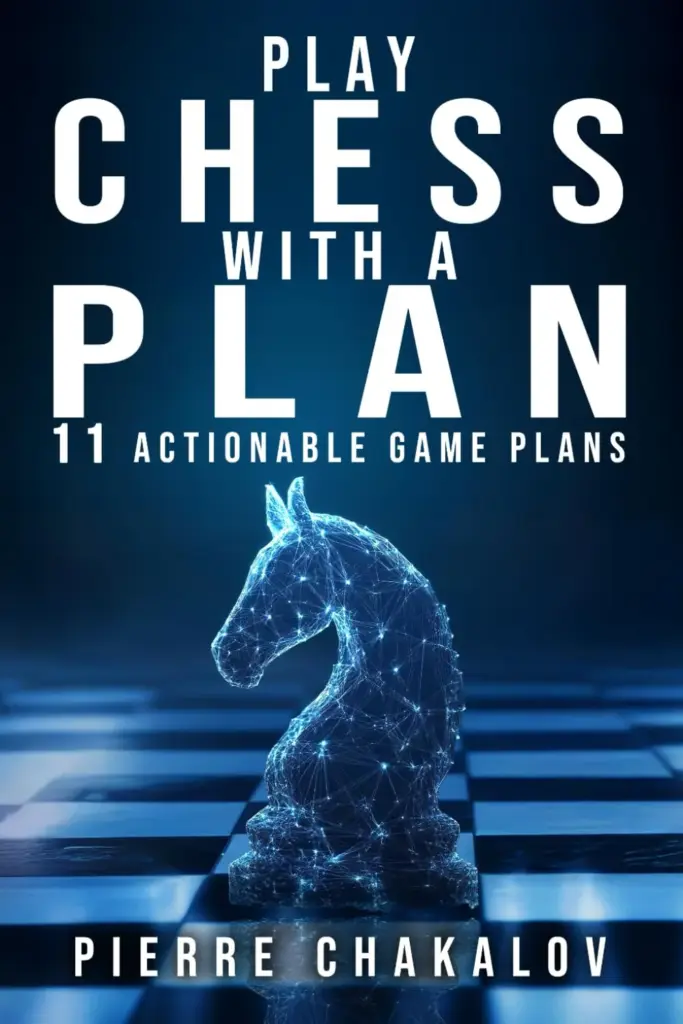
I think this may be the strangest and most unique chess book I’ve read. It doesn’t feel like a chess book at all, since it emphasizes ideas in text form, simple concepts that span over all three stages of the game, and proscribes advice without going into any specific positions.
Chakalov has introduced the concept of “strategic intent” as a necessary leitmotif one should decide upon before a chess game, and stick to it throughout, except if an opportunity arises to change directions and switch intents.
The book introduces 11 strategic intents – 11 ways to approach a chess game and 11 overarching strategies one should play towards, applying the necessary rules, patterns, and advice Chakalov has prescribed for each.
Each of the 11 intents was described in detail, along with their consequences and how they should be pursued, openings best suited for each intent, the shifts and switching between intents.
This kind of teaching is something new to me and it felt odd reading the book. Not bad, just different. A chess book without diagrams and analysis, and without specific positions one could use to illustrate the concepts it’s teaching.
Pierre was kind enough to send me a translation of a recent article published on JHM, written by Ervan Couderc.
I’m going to share several key points that may help you understand his teaching methods and how Playing Chess With a Plan came about..
“One project had been in his mind for years: writing a book on chess strategy (Play Chess with a Plan: 11 Practical Game Plans, also published in Russian and English). “There’s no shortage of chess books. But Grandmaster books can feel off-putting. You only remember and absorb advice if you actually understand it.” Chakalov wants players to embrace one core idea: chess doesn’t have to be complicated—just strategic.
To make that point, he stepped away from the chessboard and turned toward the tennis court. “I’ve played tennis, and I know several top tennis players are also into chess—Carlos Alcaraz (world No. 1), Daniil Medvedev, Andrey Rublev… When you play tennis, you have a game intention. The clearest example is serve-and-volley. When John McEnroe charges the net, he’s made that decision before he even serves.”
Before moving on to practical exercises, Chakalov gives the Léo-Lagrange players a short lecture. “If you play with a plan, the game becomes more fun than if you play just to avoid mistakes. In tennis, we’d much rather hit a winner than wait for the opponent to miss. And you don’t set the pace if you only attack from the baseline,” he explains. – Ervan Couderc, JHM
One must point out that theoretical debates on a soundness on a certain type of approach to learning chess, improving thinking processes, and transferring knowledge to the reader, are hard to prove or disprove without concrete examples. As Ben Finegold would say: “Theory and practice are the same in theory but not in practice.”
The 11 Strategic Intents
Chakalov has identified 11 strategic intents a player could steer the game towards or play according to. They are (in order):
Kingside Offensive, Queenside Offensive, Center Control, Positional Play, Defensive Play, Targeting the Endgame, Dynamic or Tactical Play, Pawn Structure Game, Prophylactic Play, Hypermodern Play, Hybrid or Flexible Play
This position is a typical example of the fight for d5 in Sicilian structures. Can you evaluate it properly?
Chessmind is a great learning platform where you can answer positional questions and get instant feedback. It recreates lesson conditions, and comes close to having a chess coach! Try it out!
The main body of the book is the description of each intent, its goals, strategies, and recommended ways to play positions according to each intent. For example, the intent of Queenside Offensive is described as “an attack on the opposite flank of the king, aimed at weakening the pawns or creating a breakthrough.” It is given typical features that accompany it, such as pawn advances with a4-a5, as well as a list of openings suited for such a strategy.
The intent is then further described by providing types of moves a player should favor if following a certain intent, as well as actionable advice such as (in the case of queenside offensive); create threats combined with queen and rook, prepare for a transition to a favorable endgame.
In a separate chapter titled Review of Openings by Intent, the author lists openings suited for each strategic intent.
Tempo and Intent Shifts
The two most applicable chapters, in my opinion, are the two chapters on Tempo and Strategic Intent Shifts.
In the chapter on Strategic Intent Shifts, Chakalov lists ways of switching plans. For each intent, he provides signals we can use to decide to switch strategies and ways to shift effortlessly. This chapter felt more useful than others, because it went beyond the limited scope of sticking to a certain overarching strategy, something that, to me, feels utopian, and hardly ever applicable during an actual game. Advice on how to switch from a kingside attack to trying to control the center, and other intent shifts were useful.
In the chapter on tempo, Chakalov compared chess to other games and sports in which dynamics matter, in particular Magic the Gathering. I have never played it, but the parallels he drew sounded reasonable. The main body of the chapter is the importance of tempo for each specific intent.
Openings recommended for each strategic intent
The author has attempted to assign suitable openings to each of the 11 intents. I think something like that cannot be accomplished. Saying that you have to attack the kingside in the King’s Gambit and play prophylactically in the Reti, to use reductio ad absurdum, and paraphrase Chakalov’s opening recommendations, seems hard to test, prove, or disprove, and the usefulness of such an approach could only be tested on a scientific level.
The useful part of the review of openings by intent is the actual review of each opening. Done on a basic strategic level, it should serve as a very good introduction to openings for beginners, teaching them the basics they could follow and what to play for in each opening, how it could go wrong for them or their opponent, and what the positional goals of each are.
Recommended Rating Range for Readers
The author mentions that the book is best suited for players between 1400 and 1800 ELO (whether FIDE or online wasn’t specified), and that those over 2000 could use his teaching methods to prepare for specific opponents by identifying their common strategic intents, and thus their weak and strong points.
My opinion is that beginners could benefit from the advice given in the book, but that they should take the rigidity of Chakalov’s method with a grain of salt. Any advanced players, and even intermediate ones, may only find little use in the advice provided in Play Chess With a Plan.
Conclusion
Chakalov introduced a new, completely unique concept into chess literature and did a good job of explaining how one may use it to improve their thinking processes and performance during games. Whether his methods are sound, applicable, and helpful, remains to be seen.