

Chessmind is a great learning platform where you can answer positional questions and get instant feedback. It recreates lesson conditions, and comes close to having a chess coach! Try it out!
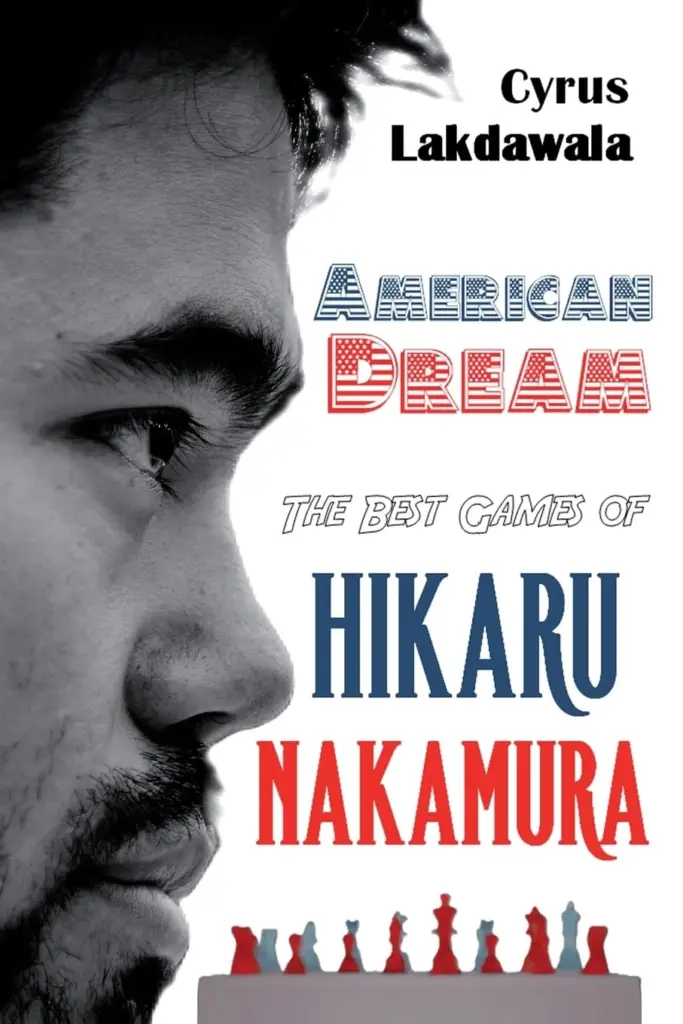
Lakdawala mentions that Hikaru was a relatively one-dimensional player when he was starting out – always playing for a vicious attack at all costs, cherishing complications over everything else, and beating his opponents by outcalculating them. That is visible in his early games presented in the book. Whether as a result of a statistical bias by the author or because Hikaru really did attack at all costs, would require a detailed analysis of all of his early games.
His development as a player is highlighted in the final two chapters. The author correctly describes Hikaru as a well-rounded player, capable of winning long endgames and slow, technical positions as well as tactical skirmishes. The chapter on Accumulating Advantages was my favorite, since it shows Hikaru in an unconventional light. Lakdawala mentions how he used to play Hikaru on the ICC back in 2002, 2003, and 2004, when Hikaru’s strength grew rapidly. In the beginning, he was able to beat the young genius. Just a few years later, once his strategic and positional understanding grew, Lakdawala was left defenseless against a well-rounded tactical monster capable of excelling at any type of position.
Each chapter, except the third one, on dynamics of Hikaru’s play, which is the longest, consists of roughly 10 annotated games.
Quality of Annotations
One thing that needs to be highlighted is the interactive element in the book, sprinkled across the annotated games. Lakdawala will throw in questions, tips, and strategies for the reader. For example, in game 22, he gives an exercise: “(combination alert) White’s f2 rook is attacked and black’s queen simultaneously threatens to invade on h2, and then on to h1 and g2. How should white respond?”
For those interested in looking the position up, it’s the game Nakamura – MVL from Norway Chess 2017, a SIcilian, and the position refers to move 32 for white. Answer: “ Overloaded defender. The f4 pawn can be taken since any recapture with black’s rook allows white to promote on b8 with check.” (Lakdawala 2024, 75)
The author gives other tips which make the annotations more instructive, especially for beginner and intermediate players; In game 24 (Nakamura – Oparin 2022, Nimzo-Indian), for example, he says:

“White’s ideas include: 1. Pushing the h-pawn further up the board to induce weakness around the black king’s pawn-front. 2. Possible pawn storms with g2-g4 later on. 3. Lifting the h1 rook to h3 and then to g3, taking aim at g7. 4. h2-h4 can become a hook for a potential future piece sacrifice, with a future Bg5 or Ng5. If black responds with …h7-h6, white might consider just leaving the piece on g5, since if black captures, then white opens the h-file with hxg5.” (Lakdawala 2024, 79-80)
I found these tidbits of useful information scattered throughout the book very engaging and instructive. I wish he had included them after every couple of moves. That would have made the book even more useful for lower rated readers. Each game usually contains one or two.
The annotations themselves are good, but not perfect. There are often sequences without annotations, or sidelines given no comments whatsoever. That is typical, though, and seldom does a book come close to New York 1924 by Alekhine and Learn From the Legends 1 and 2 by Marin, the only perfectly annotated books I’ve come across thus far.
Difficulty and Recommended Rating
The Best Games of Hikaru Nakamura is a good book for beginners, because of the tips and plans mentioned for many positions in the book. However, due to the lack of annotations for many move sequences and sidelines, I think it’s best suited for advanced and intermediate players, 1600 FIDE and higher.
Conclusion
The Best games of Hikaru Nakamura is a good game collection, especially for aspiring attackers. It covers 72 of Hikaru’s best games, divided into 5 chapters by theme. It’s annotated well, but not perfectly. What’s unique about it is Lakdawala’s strategic tips and exercises given for many positions in the book, raising the instructive value of the annotations. Not an easy read, and definitely a book that requires you to set up positions over a board while reading.
Other Game Collections on attacking players like Hikaru you might like