Introduction
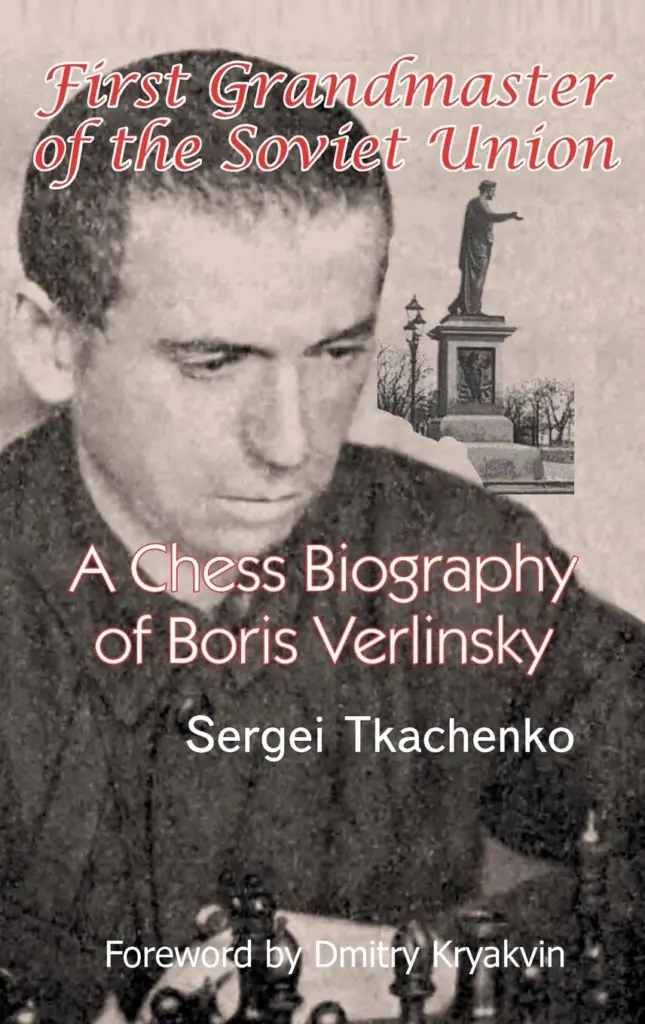
First Grandmaster of the Soviet Union is the new book by the Ukrainian chess historian and world champion at chess compositions, Sergei Tkachenko. His previous book, Alekhine’s Odessa Secrets, that came out in 2017, was a very pleasant read. He didn’t disappoint with his new biography. The book covers an unknown player by “elite” standards, Boris Verlinsky. Verlinsky was born in 1888 in Ukraine, in Bakhmut. He was one of the top Soviet players during the 20s. He was the first Soviet player to receive the Grandmaster title.

Verlinsky was a talented player whose peak rating was over 2600. He scored wins against many strong elite players like Bogoljubov, Spielmann, Rubinstein, or, most famously, Capablanca, during the Cuban’s peak at the 1925 Moscow tournament. He got awarded the GM title after winning (!) the Soviet Championship in 1929, his biggest tournament success.
Verlinsky was a fascinating player and person. Tkachenko describes numerous episodes from his life which makes the book a very enjoyable read. As opposed to the major stars of his era, like Alekhine and Capablanca, Verlinsky is almost unknown today. That is precisely why his biography is both more interesting and more valuable than those of better known players.
Verlinsky’s Strength and Playing Style
Verlinsky was, by all accounts, and easily visible from his games, a very strong and a very aggressive player. Some of his games reminded me a lot of Tal or Kasparov. He played uncompromising chess and strived for the initiative at all costs.
He was a very strong player. As is visible from the games Tkachenko included in the book, many of which were played against the absolute best of his generation, like Alekhine, Verlinsky was up there with the best. I think his technique may have been lacking compared to Capablanca, Alekhine, or Rubinstein, but his dynamic play compensated for that.
Boris Verlinsky played Efim Bogoljubov during the USSR Championship in 1925. This is the position on move 16. How would you evaluate it? Who is better and why? Verlinsky, with white, showed great understanding and prowess here!
Chessmind is a great learning platform where you can answer positional questions and get instant feedback. It recreates lesson conditions, and comes close to having a chess coach! Try it out!
Structure of the Book
Having read a book by Tkachenko before, I knew what to expect. He is a historian first, so Verlinsky’s biography is structured chronologically, covering the most important events of both his life and his chess career. The historical data is presented very scientifically, and the author gives detailed sources and descriptions of the events. Tkachenko never fails to mention additional information on Verlinsky, or on his contemporaries, making the book feel a bit too detailed. I was often waiting for him to get to the point. For example, in the chapter on Verlinsky’s early life, we can read descriptions of the house he used to live in, who else lived there, which shops were at the ground floor, what his brother did, or who moved out, etc. That’s great, don’t get me wrong, but it takes Tkachenko a long time to get to the chess!
The book is divided into 11 chapters, spanning from the late 19th century to the post WW2 era. Each chapter is accompanied by games or fragments. Each game is given context. I love that. So this is more than a game collection, and it feels as if the games are accompanying the biographical part of the book.
The Annotated Games
There are 130 annotated games and fragments in the book. The author explains how the games were presented in the intro where he says that he would check selected games with an engine to either annotate it or to supplement existing annotations. His own work was then expanded by several strong players, GM Dmitry Kryakvin did most of the added annotations. The other annotators were Ukrainian GM Kiril Shevchenko, GM Mikhail Brodsky, Igor Yarmonov, Andrei Tobak, and Dmitry Markin.
But, the biggest value of the annotations lies in the vast array of notes by the players themselves. Some of Verlinsky’s opponents wrote notes on the games, and those were included in the book.
Combining all the sources of analysis resulted in a very well annotated selection of games. It was refreshing to be able to actually read a book with only one chess board!
Conclusion
Tkachenko has written another well researched and well written biography accompanied by 130 of Verlinsky’s best games with annotations by the author, the players themselves, and additional notes by several strong players. The book is an easy read and a great resource for dynamic players, as Verlinsky’s style very much resembles that of Tal or Shirov.
Other Chess Biographies You Might Like
- ELO: 1600
- -
- 1800
- From Vienna to Munich to Stockholm: A Chess Biography of Rudolf Spielmann
- Grigory Bogdanovich