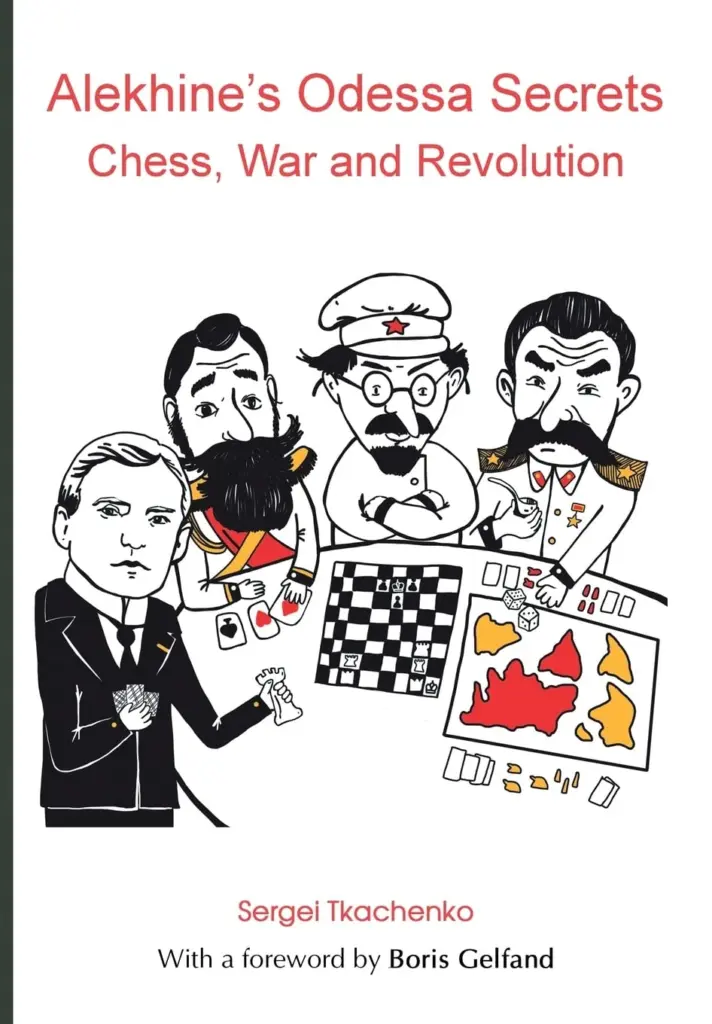
Introduction
Alekhine was born in 1892 in Moscow. By the 1920s, he became one of the strongest players in the world and would usually win any event he played in. In 1921, after the war, he left the Soviet Union and settled in France. In 1927 he defeated Capablanca and became the World Champion. He held the title until his death, although there were attempts to strip him of his glory after the second world war. He died in 1946, a day after his match for the World Championship against Botvinnik was finally arranged.
“I do not play chess – I fight at chess. Therefore, I willingly combine the tactical with the strategic, the fantastic with the scientific, the combinative with the positional, and I aim to respond to the demands of each given position.“ ― Alexander Alekhine
From the 20s onwards, episodes from Alekhine’s life are well known and often covered in chess literature, especially those post his match with Capablanca. What took place before that, during and shortly after the first world war is a seldom chosen topic by chess historians. The reason is obvious – lack of information. It had taken Tkachenko a very long time to collect and compile the information he had managed to dig up about the obscure years of Alekhine’s career. Albeit centered to one specific city and events surrounding it, they offer valuable insight into Alekhine’s war years, his struggles with authorities, his relations, his less formal matches, simuls, and blindfold exhibitions, and his journey to reaching the chess elite.
“I found this book so fascinating that I read it virtually non-stop! Not only did I learn about previously unknown episodes of Alekhine’s life, but I was also introduced to long-forgotten Odessa chess players who were colleagues of the future chess king. They helped to found the famous Odessa chess school that would provide the world with a slew of outstanding grandmasters, including Effim Geller, Vladimir Tukmakov, Lev Alburt, and Konstantin Lerner.” ― Boris Gelfand in the Foreword
The author, Sergei Tkachenko, has recently written the excellent First Grandmaster of the Soviet Union: A Chess Biography of Boris Verlinsky, published in 2023.
The Structure of Alekhine’s Odessa Secrets
Alekhine’s Odessa Secrets – Chess, War and Revolution is a biographical work, not a game collection. Tkachenko, who is an ex-world composition champion and a strong player in his own right, has attempted to join the ranks of chess historians. His debut is a great success!
The book is structured chronologically, and it consists of seven chapters, each covering a period in Alekhine’s life. The first four chapters cover Alekhine’s visits to Odessa – three in total, spanning from 1916 to 1919.
Tkachenko provides previously unknown information and previously never published photographs and article clippings that give us a glimpse of what it was like to live and play chess in Odessa during and after the first world war.
Chapter five covers Alekhine’s years in Moscow, during the late 1910s and the early 1920s, when Alekhine briefly enrolled at the First State School of Cinematography, giving it up by the end of 1919 to pursue chess full time. The author introduced thrilling information on Alekhine I had never read before – his marriage to Alexandra Bataeva, his employment as an investigator at the Wanted Persons Department of the Central Police in Moscow, and the Cheka, the first Soviet secret police, the predecessor of the KGB, bringing him under close surveillance. How those two things could have happened in a single year is truly remarkable.
Other books on Alexander Alekhine you might like:

There are many articles and appendices supporting the facts brought by the author. None of it is conjecture, which gives the book a feel of a true scientific work. During my time in college, and while working on my masters thesis in medieval archaeology, I have read much worse and less professionally written research papers and books!
Chapter six covers Alekhine’s years in France, after his immigration in 1921, and the final chapter uncovers (or attempts to) the mysteries surrounding Alekhine’s final years.
I found the final chapter captivating. May the author excuse me, but the events surrounding Alekhine’s struggles with chess authorities, his attempts to reclaim his former glory and clear his name of the adjective “collaborator” after WWII, and his mysterious death, albeit already explored and written about before, were a far more enjoyable read than the events that had taken place in Odessa.
Alekhine’s Dark History
When WWII broke out, Alekhine was living in France. He enrolled in the French army as a translator in 1940, but France, as we know, didn’t hold out for long, and a German rule was established. Alekhine, being the chess world champion, was a great potential tool in the hands of the regime. The result of that was that in 1942, Alekhine had written his highly controversial, entirely atrocious, and completely useless article titled Jüdisches und arisches Schach. I will not share any part of this absurd work, and neither has the author in the book. Those curious enough can easily find it online. Alekhine may have been afraid that his estate in France would be taken away, or he may have truly shared the monstrous ideology he had taken part in, I don’t know, no one does, but the fact remains, he did write that article, to his eternal shame.
As a result, after the war, Reuben Fine, and other prominent chess figures called for FIDE to strip Alekhine of his title, which he had, at that point, held for almost 20 years. That never officially happened. Personally, I think that he should be remembered as a chess genius, a coward, and a man who had dishonored himself and his legacy by, for whatever reason, stooping down to being a tool in the hands of a monstrous regime.
After the war Alekhine lived in Estoril in Portugal. In the midst of his attempts to clear his name, Alekhine struggled. Tkachenko gives a full transcription of Alekhine’s letter to the organizer of the London tournament in 1946, in which he pleads for understanding – a letter prompted by loud protests from Euwe, and many American players who had threatened to withdraw from the tournament if Alekhine was allowed to participate.
During those months Alekhine received a letter from Mikhail Botvinnik asking for a World Championship match and a chance at a title. Thrilled – Alekhine accepted! Preparations began and Tkachenko gave several detailed accounts and sources by chess figures at the time. When the match was finally arranged and the location – London – decided upon, Alekhine died. He died and was found the very next morning in his hotel in Estoril.
Whether his death, attributed to choking, which the author attempts to refute, was of natural causes or not, we will never know. But the fact remains that the Soviet authorities surely wanted nothing to do with a disgraced old-timer convicted of collaboration. They surely didn’t want a match between Botvinnik and Alekhine to take place. And thus, Alekhine died. He was buried at the Montparnasse cemetery in Paris.
Alekhine’s Games From Odessa
This is a game in which Alekhine had black against Verlinsky, his Oddesite opponent in many games. Verlinsky wasn’t a bad player! White to play. How would you evaluate it?
The author provides 25 annotated games Alekhine played during his visits to Odessa. They almost serve to accompany the biographical part of the book and provide chess context to the events. The games are annotated, but not in detail, which is fine considering the nature of the book.
Many of the games were played against a few relatively strong Odessites, most against Verlinsky, who even managed to beat the champion! Some games were odds games, where Alekhine would play without his f7-pawn, some were blindfold games, and some were simuls. Most were played in romantic-era openings; King’s Gambit, Danish Gambit, or the Scotch, which is why the majority are one-sided miniatures.
Conclusion
Alekhine’s Odessa Secrets is an intriguing historical overview of a seldom explored part of Alekhine’s life and chess career, and it focuses on his time spent in the author’s home town of Odessa. It’s a short and enjoyable read and not a workbook you will struggle through. A great bedtime chess book for any rating!
Other intriguing chess biographies you might like: