Introduction
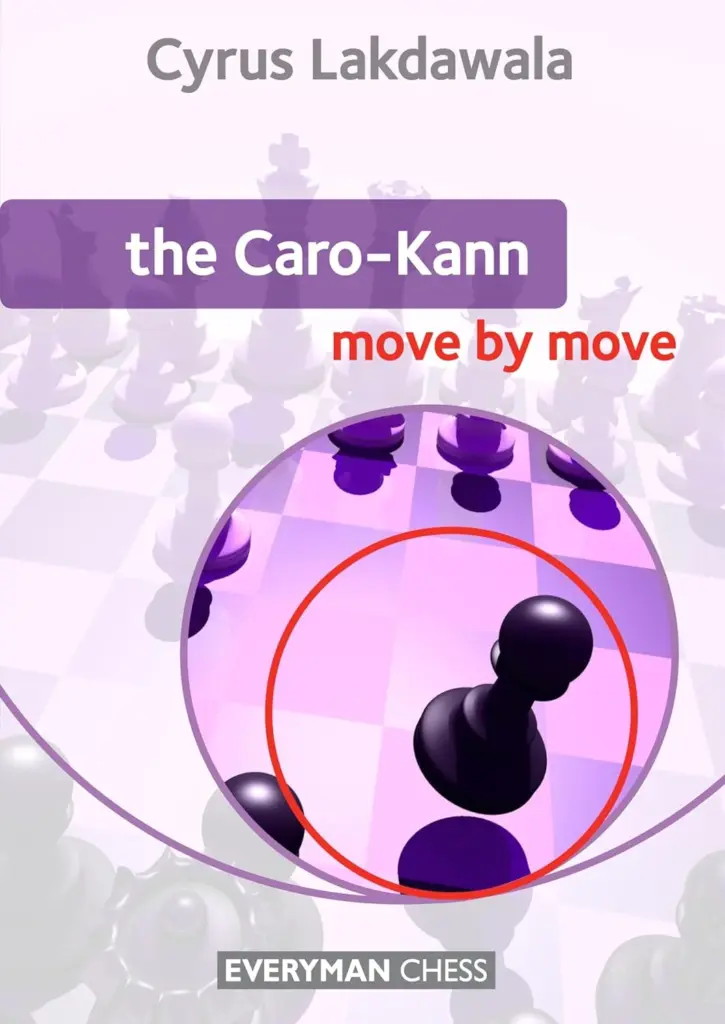
Cyrus Lakdawala is a chess author, first and foremost. He has written over 60 books. He is also an American chess International Master and journalist. His books on openings cover pretty much everything. Now, how can someone write a book on every opening in existence? Since I have tried to do the same thing with opening videos, I think I can safely say that it’s possible, but the quality will surely be lacking, as real-life playing experience, or the lack of it, will surely be clearly visible to readers. When I cover openings I haven’t played, I struggle. Lakdawala has played the Caro-Kann on several occasions. He has 6 recorded games in it. Compared to Houska’s 200 games, or Bologan’s vast experience, we can safely say that Lakdawala’s coverage of the Caro-Kann must be less in depth and harder to follow when it comes to explaining ideas and strategy.

That being said, despite his mass-production of chess books, especially opening books, most of them are good enough. I would say that none of them are targeted at an experienced audience though, and they will be better suited for beginners.
Other Books by Cyrus Lakdawala
- ELO: 1800
- -
- 2000
- Opening Repertoire: Queen’s Gambit Declined: Tarrasch
- Cyrus Lakdawala
- ELO: 1800
- -
- 2000
- Opening Repertoire: The Modern Defence
- Cyrus Lakdawala
- ELO: 1400
- -
- 1800
- The Alekhine Defence: Move by Move
- Cyrus Lakdawala
The Games
Each chapter is accompanied by annotated games, which are the basis of the learning material. That’s a different approach as opposed to most opening books. It makes his book easier to follow but it also makes it more difficult to actually learn the Caro-Kann theory. There are no “variations” in the book per se. Each chapter consists of annotated games, exercises in key positions, and questions and answers accompanying important diagrams. So don’t think of this as an opening book. It’s a game collection of Caro-Kann games divided by variations.
Aron Nimzowitsch had white against Jose Raul Capablanca in New York 1927. Capablanca played one of his few Caro-Kann games against him. What they had on move 33 for white is a very typical, complex Caro Advance endgame structure. See if you can evaluate it properly. White to play. Who stands better and why?
Chessmind is a great learning platform where you can answer positional questions and get instant feedback. It recreates lesson conditions, and comes close to having a chess coach! Try it out!
The Questions and Answers
One unique thing about the move by move series are the sections that accompany many diagrams in which the author poses a question and gives an answer. Those segments are very useful as most questions are devoted to simple tactical or strategic problems. They are a great resource for lower rated players.
There also exercises scattered throughout the book. In key positions, usually tactical, the author gives diagrams with specific tactical questions. Those are a welcome addition to the annotated games as they help engage the reader and force them to work on their own.
Recommended Variations
What makes this book unique is Lakdawala’s coverage of Qb6 against the Fantasy and the Karpov against Nc3. Those variations are rarely recommended so this is one of very few books from which you can study them with guidance. Everything else he covers is pretty common.
Struggling with building an opening repertoire? With Chessbook you will only spend time on the moves you’ll actually see. It lets you easily identify mistakes in your online games, play through model games that follow your repertoire, learn middlegame plans for any opening and find the gaps in your repertoire before your opponents do. Try it out!
Nc3 Classical Systems
Against Nc3, Lakdawala recommends the Karpov. I was pleased to see that, as not many authors are willing to begin explaining the complications connected with playing Nd7 as opposed to the more popular Bf5 or the Tartakower. I’m yet to find a book that focuses on my current favorite, the Gurgenidze! I have been playing the Karpov for 6 or so years, but I have switched to g6, since it simplifies black’s play significantly. I recommend it in my new Caro-Kann repertoire. Within the Karpov, Lakdawala devotes a separate chapter to Bc4 and to Ng5.
Advance Caro-Kann
Against the Advance, Lakdawala recommends Bf5, and covers the Short, the Van der Wiel (he calls it the Nunn-Shirov Attack) in separate chapters. The rest of white’s 4th move alternatives are bundled in a single chapter titled “alternatives”. In it, he covers the Tal, the Bayonet, c4, Bd3, and other moves. That’s not a good structure. How is the Tal less important than Nc3 and as important as the dubious Bd3? The biggest flaw of his coverage of the Bf5 advance is that he doesn’t cover Nd2 and the Bronstein, Ne2. If you wanna learn the Advance for black, there are far better sources, namely Bologan’s Caro-Kann.
Exchange Variation
Against the Exchange, Lakdawala, just like Houska, recommends Qc7 and avoids theory.
Fantasy Caro-Kann
Against f3, he recommends Qb6! This is my favorite move so I was happy to finally find a resource on it. The book came out in 2012, which makes his choice even more astonishing, since the line was seldom employed until recently. Now it’s the top engine recommendation.
Panov
Against the Panov Lakdawala plays it safe. He recommends the slow 5…e6, followed by Bb4, which is currently the main line. I dislike this variation because it’s very difficult for black to equalize after shutting in the light squared bishop.
Other Variations
The Accelerated Panov and the Breyer are covered, but not well in my opinion. The Two Knights, against which Lakdawala plays Bg4 is covered well, but there are better sources, such as Houska’s 2015 book. There are several missing minor lines, such as the Goldman and the Hillbilly attack, but we can forgive the author for that as they are seldom played on anything close to decent level.
Conclusion
Lakdawala’s Caro-Kann is divided into 12 chapters and it covers almost everything black can face in the Caro-Kann. There are no “variations” in the book per se. Each chapter consists of annotated games, exercises in key positions, and questions and answers accompanying important diagrams. So don’t think of this as an opening book. It’s a game collection of Caro-Kann games divided by variations. It’s best suited for intermediate players and will be easy to follow even for beginners.
4 Better Resources on the Caro-Kann for Black
- ELO: 1600
- -
- 2000
- Opening Repertoire, The Caro-Kann
- Jovanka Houska
- ELO: 1800
- -
- 2200
- Playing the Caro-Kann: A Counter-attacking Repertoire
- Lars Schandorff