Introduction
“We have already told you numerous times to give up chess; you have no talent for it”
“You do not know what a chess problem is. You are not aware of the principles of mate purity and economy. Variations and hidden initial moves subsequently give value to the problem. The five-piece complex you submitted is everything but a problem. Do not hesitate to purchase Zsigmond Schuster’s manual on the Poetry of Problems. It will give you a different understanding. The wastepaper basket was not a deep enough graveyard for your submissions.”
“It is a waste of your time to engage in problem composing. Someone who cannot see one-move mates in such a simple position and starts with a capture would be better off playing dominoes, even though that is a difficult game too.”
These are some of Maróczy’s replies in the chess column he had been writing for a Budapest newspaper for over 20 years. They show his nature, his wit, his sense of humor, and his inability to tolerate chess “civilians”. I found them adorable! The Life and Games of Geza Maroczy is full of tidbits of interesting information like this that depict Geza as a man, not just a chess player.
Jakobetz has covered Maróczy’s prolific career, both in and outside of chess in 11 chapters; from his early years, to his golden age, and finally to his late years and why and how he managed not to retire and how he continued to play chess until he died. He was one of the best players in the world for over 50 years. Not a single top player, apart from perhaps Lasker can boast a career that long and full of triumphs. Maroczy played chess. He never stopped or retired. His last tournament was Baarn 1947, four years before his death, when he was 77 years old.
The Maróczy Bind
To paraphrase a famous Seinfeld quote: “I like carrots, but I’m in Idaho, I want a potato.” When I read a book on Maroczy, I expect to hear about the famous Maróczy Bind. I’ve been playing chess for 9 years, and I’ve employed Maroczy’s greatest innovation countless times. I wasn’t disappointed to learn that the Hungarian master has contributed so much more to development of both opening theory and middlegame strategy and that his reach went far beyond putting your pawns on e4 and c4 and preventing d5. Today we know the Fantasy Variation in the Caro by two names, the second being the Maroczy Variation. The gambit that arises after 1.e4 c6 2.d4 d5 3.f3 dxe4 4.fxe4 e5 5.Nf3 exd4 6.Bc4 is definitely his invention! He was also a remarkable technician, and his endgame and middlegame technique is visible in all types of positions. By the time I finished the book I had all but forgotten about the bind, which, even though I haven’t kept an actual count, is mentioned seldom, perhaps only a few times.
Maroczy was a chess genius and one of the best players in the world for 40 years! He is, perhaps unfairly, best known for the Maroczy Bind, a structure in which white has pawns on e4 and c4, clamping down on the d5 pawn break. Here is a game he played in 1906 against Hermann Voigt. Maroczy had white and he played the famous bind. How would you evaluate the position?
Wanna solve more positional problems and get instant feedback just like you would during a lesson with a real chess coach? Continue training!
The Structure of the Book
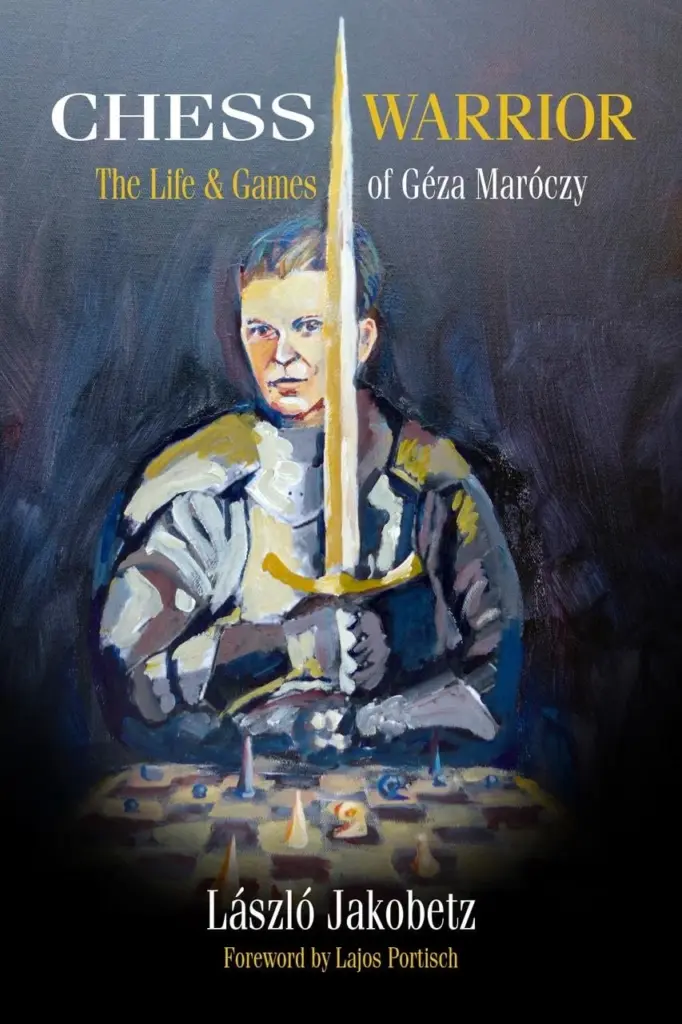
Chess Warrior, The Life and games of Geza Maroczy is structured by important periods of Maroczy’s life. From his early years and battles in the cafes of Budapest, to his great successes on the international stage, and finally to his late years. The emphasis is put on his life, not on the games themselves, so if I had to choose I would say the book is a biography first, and a game collection second.
It features 180 games played by Maroczy. They were all annotated, but not in great detail. Each game is only given a page or two. The annotations are better than in most modern game collections though. Jakobetz has managed to give depth to each game and he provides a lot of instructive value in his notes. The book has greater instructive potential than most Karolyi books, for example, and Tibor Karolyi is revered as one of the best chess biographers today.
Most importantly, context is given to every single game. Tournament conditions and standings, photos, excerpts from magazines, Maroczy’s own notes, letters and articles, and tons of other sources are provided, giving each game a frame. I loved the structure and I haven’t read a game collection this well written and planned yet.
Conclusion
Read this book. Even people who don’t play chess would enjoy it. I tried not to spoil anything in the review since Maroczy led a truly fascinating life. The same can be said about his approach to chess. You will learn a great deal about chess and about how to play chess from Jakobetz and Maroczy. I recommend using a board while reading even though the annotations and diagrams alone are enough for any advanced player to follow the analysis without one.
Other Game Collections You Might Like
- ELO: 1800
- -
- 2000

- Sofia Polgar, Amazing Artist – Dangerous Tactician
- Sofia Polgar
- ELO: 1800
- -
- 2000
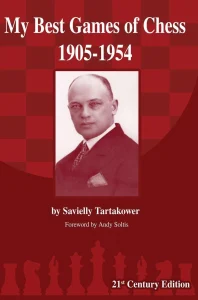
- My Best Games of Chess 1905-1954
- Savielly Tartakower
- ELO: 1800
- -
- 2000
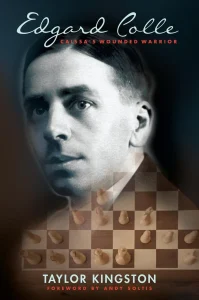
- Edgard Colle – Caissa’s Wounded Warrior
- Taylor Kingston
- ELO: 1800
- -
- 2000
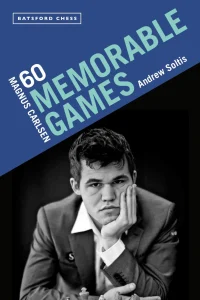
- Magnus Carlsen: 60 Memorable Games
- Andrew Soltis