Introduction
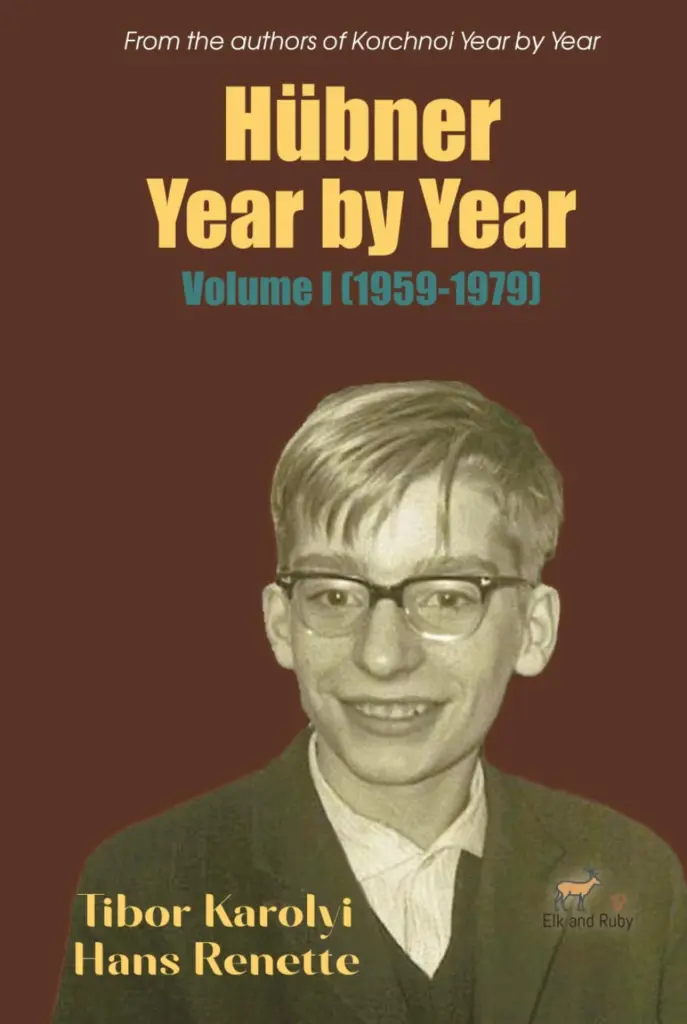
This is the first volume in the new Year by Year series by Tibor Karolyi and Hans Renette. It follows the early part of Robert Hübner’s career, from 1959 to 1979. The two authors follow the same tried receipt they have used while writing their four-volume series on Korchnoi, also published by Elk and Ruby. Karolyi worked on the chess part, providing game analysis, and Renette wrote the biographical part. Tibor Karolyi is well known for solid game collections. His previous works include Boris Spassky’s Best Games, his famous Karpov’s Strategic Wins, and many other books, including his endgame virtuoso volumes on Karpov and Carlsen. Thus, reading a new Karolyi book is always a pleasant experience and one can expect very little surprises. I have to say, though, compared to Spassky’s games, which I was slightly disappointed with, Hübner’s game collection is as good as Karolyi’s best works.

Other Game Collections by Tibor Karolyi
- ELO: 1600
- -
- 1800

- Kasparov: How His Predecessors Misled Him About Chess
- Nick Aplin, Tibor Karolyi

- ELO: 2000
- -
- 2200+

- Karpov’s Strategic Wins 1, 1961-1985 The Making Of A Champion
- Tibor Karolyi

Hübner, who died only recently, in 2025, was one of the chess elite in the 70s and 80s. He was ranked number 3 behind Karpov and Korchnoi in 81, and his successes include many tournament and match wins, most notably reaching the 80-81 candidates final. He was, if you only look at his results, a player that deserves way more praise and publicity than he got during his lifetime. He was the best German player since Lasker, by a wide margin.
Volume one of the series covers his early years, his rise from prodigy to candidate in the 70-71 cycle, his gold-medal performance at the 72 Olympiad, and it ends with his shared first place in the 1979 Interzonal.
The book covers 159 annotated games and fragments. Karolyi presents Hübner as a versatile, resilient player, who matched the giants of his generation like Fischer, Karpov, Spassky, Petrosian, Smyslov and Tal. The biographical portion of the book was compiled by Renette by interviewing people who knew Robert and by compiling all available sources, albeit few in comparison to the careers of more popular players like Tal or Fischer. Hübner even provided some information himself, although his health had been on the decline when the project began.
Structure of the Book
Hübner Year By Year is structured, not surprisingly, by year. The book is divided into 18 chapters, one per year except for the first, in which the authors cover 1959-1962, Hübner’s ages 11-14. An additional chapter is devoted to photos of Hübner.
Each chapter consists of a brief introduction and is supplemented by excerpts of historically significant information when available. The main body are the games. This is a game collection, and not a biography. The games themselves are given context with Renette’s writing, and not the other way around, as is the case with many other biographies, such as Bobby Fischer and His World.
Hübner’s Career
Karolyi writes: “Investigating Hübner’s play brought me some surprises. In particular, I had not foreseen certain qualities like his extreme resilience in endgames. He is probably the only player to have survived a very difficult endgame against Fischer, and he held clearly lost endgames against not only Kasparov, but also Karpov. His games are highly entertaining and one can learn a lot from them.” (Karolyi, Renette, 2025, 9)
This is a position from the game Miguel Najdorf and Robert Hübner played at Hoogovens (Wijk aan Zee) in 1971. It was the Huebner Variation of the Nimzo, the only variation of note named after the German genius. This complex position occurred on move 35 for black. How would you evaluate it?
Wanna solve more positional problems and get instant feedback just like you would during a lesson with a real chess coach? Continue training!
Renette writes about Hübner as a man and as a player. He says: “It was not Hübner’s ambition to conquer the chess throne and he combined playing the game with studying other activities. But then his meteoric rise began…”(Karolyi, Renette, 2025, 10). The most important part of his career was his ascent to the candidates in the early 70s. He faced Petrosian in the quarterfinals and lost, but, as Renette puts it, “in a most controversial way”. Robert focused on other things after that cycle, but he remained an active player and took part in the 1973 and 76 cycles and came close to qualifying for the candidates once more. The book finishes with his 1979 interzonal performance. His play, at least to me, seems of the highest quality during that year and that event and entire cycle. He qualified for the candidates again. Renette writes: “For the second time, he thus became a Candidate and would soon be at the centre of everybody’s attention – but those tragic episodes will be covered in the second volume…”
Hübner’s Games
Hübner’s chess is the focus of the series. Karolyi annotated 159 games and fragments. By chance, I have been exposed to his games a few years ago. My ex coach loved his style and thought highly of Hübner as a technician and converter of both equal and better simplified positions.
We studied his games for a better part of a year during our lessons. I remember his game against Westerinen from Sombor 1970 especially (game 67 in the book). A six on six rook endgame that had taken us hours to analyze. The game was given additional context with a long paragraph post analysis. Renette writes: “The story goes that Hübner decided to learn Finnish after this game, as he was otherwise unable to communicate with Westerinen. His love for the language and the country soon blossomed, as Westerinen left him enthusiastic about the country’s nature and mythology.” (Karolyi, Renette 2025, 206). Paragraphs like these are what makes the book go beyond useful in a chess sense.
Not every game is given special attention like the one above, which is understandable. Another game I remember well and was a bit disappointed with with its annotations while reading is Hübner-Petrosian from the 1972 Skopje Olympiad (game 89 in the book). My coach and I had spent at least two full lessons analyzing the variations after 20.Rae1 and the following 7 moves. You can imagine my disappointment, then, when I found that Karolyi had only devoted two and a half pages to the entire game. I have a notebook with ten times more detailed annotations of the game at home.
But, that’s almost always the case with game collections. There are very few that meet my high standards for quality and quantity of annotations. In reality, the author can always do more, reference more, mention more sidelines, and explain in more detail. Karolyi’s annotations are good enough.
I think they make the book suitable for any advanced player. Beginners would struggle as he often neglects to explain the basic patterns and possible mistakes that may not be apparent to a novice.
Conclusion
Hübner Year by Year is the first volume in what will become a great, complete collection of important games by the greatest German player since Lasker. Karolyi has provided the annotations, the chess historian, FM Hans Renetter, has written biographical sections of the book that accompany the games. The book is valuable because Hübner is relatively unknown compared to other elite players from his generation, such as Petrosian, Fischer, Karpov, or Korchnoi, or those who came past his prime, such as Kasparov.