Introduction
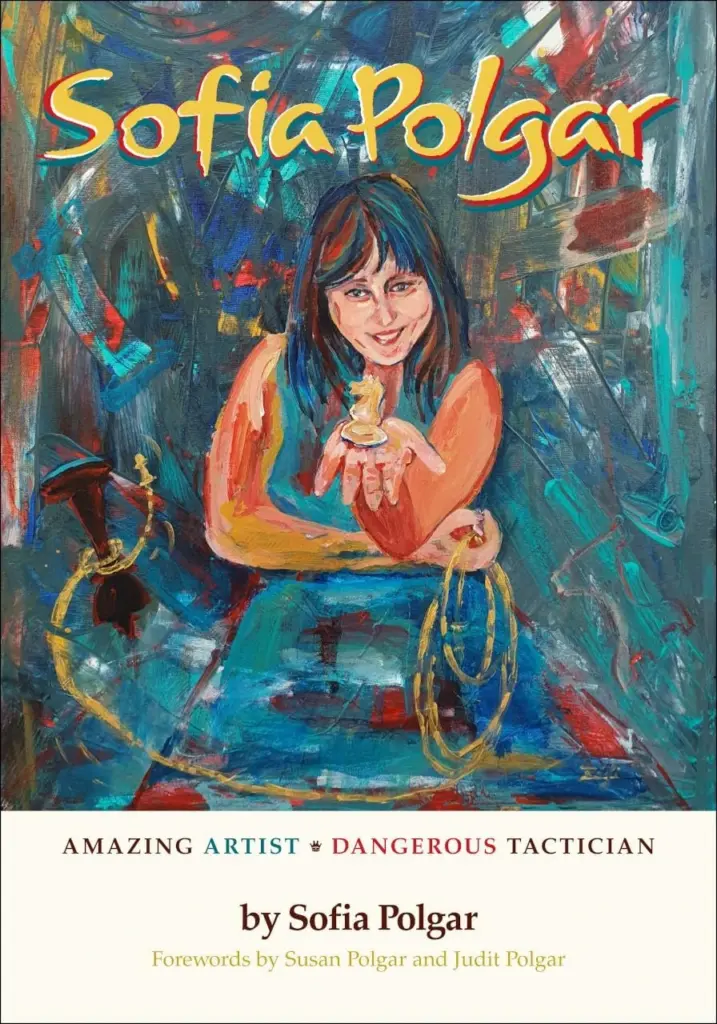
Sofia Polgar wrote a good tactics book for beginners. I have to admit that I was looking forward to reading her chess biography, and was surprised to find that the book only does that to accompany an introduction to simple tactics. That being said, she does talk about her upbringing in the famous Polgar family, her two sisters, Judit and Susan, and their father Laszlo. Amazing Artist, Dangerous Tactician is a strange mix of an art book, a biography and a primer on tactics. It’s difficult to categorize the book, but, from a chess perspective, it should teach beginners the basics of simple tactics; pins, discovered attacks, checkmate patterns, using open files and diagonals, etc.

Sofia is a painter. She used to focus on chess, but now her art is her main occupation. Throughout the book, you can see her work. Her paintings are often chess-inspired or chess-related.
This is my favorite game played by Sofia Polgar. She was white against Semon Palatnik during the Rome Open in 1989. This is the position on move for white. Sofia seems to have a promising attack! How would you evaluate the position? Is she better and why?
On Chessmind you can solve positional problems and get instant feedback like you would from a real coach, you can learn from numerous opening courses, practice tactics adapted to your strength, and get access to ChessGPT! Try it out!
The Biographical Part of the Book
The book is remarkably light. Sofia writes about her life in a simple way, describing her life, her childhood, being raised in a family of “predetermined” geniuses under the strict but loving regime of her parents, as well as her chess beginnings and triumphs.
Sofia was the middle sister. Judit was the youngest child. She became the only woman to reach top 10 in the world. Susan was the eldest. She became the Woman’s World Champion in 1996 and the first woman to earn the Grandmaster title. Sofia became a strong player herself, although never really achieving the successes of her siblings. She was the 6th highest rated female player at her peak.
The three sisters were brought up in an unconventional way. In Hungary in the 70s, people were very seldom nonconformists. The Polar sisters’ parents were both teachers, and they devised a home-schooling experiment that focused on chess as the area of expertise. Initially their “experiment” was to involve 6 children, but their mother had decided that she’d had enough after 3. Both their parents earned their PhDs based on their work and research with their daughters.
Sofia’s childhood was focused on chess, but she hadn’t been forced into anything, nor did she feel pressure to achieve success. It was training, work, and play with her two sisters. She describes her father’s vast chess library, and how she and her sisters would solve chess problems and constantly train.
Four Books by Sofia’s father Laszlo Polgar
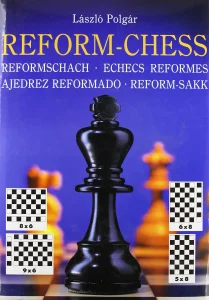


The Polgar sisters took the world by storm. In 1988, at the Thessaloniki Olympiad, they won the women’s team gold! First ever for Hungary. Judit, who was only 12 at the time, earned the individual gold with the score of 12.5/13. After that, they dominated the world of women’s chess for two decades.
The book covers episodes from Sofia’s life beyond this point, but, as a chess reader, I was mostly interested in her early childhood, and finding out what exactly their father had them do for training. We’ve all read his famous 5334 Problems, one of the most famous tactics books in history. Alas, Sofia doesn’t go into great detail. You will not get a training regime for future world champions in this book!
The Quality of the Book
One thing I must mention is the quality of the book. And by that I mean the quality of the print, the paper, and the design. Most chess books are utilitarian. This one, being a hybrid between a chess book and an art book is remarkable. It’s in color, with thick glossy paper, and it feels like reading a Taschen book on a famous 19th century painter like Degas or Renoir.
The page design is akin to art books. The text is in a large font, easily readable, and broken up by diagrams as well as pictures of Sofia’s art and photos of herself and her family.
This is unlike any other chess book I’ve held. It feels expensive. I wish chess books were printed and designed in this high quality on a regular basis.
Tactics For Beginners
The chess part of the book is really a very simple tactics course. Sofia gives brief introductions to basic patterns using examples from her own career. Most positions came from her own games and contain tactics that wouldn’t go beyond 1500 in any online puzzle trainer.
Each pattern, such as back rank issues or pins and discovered attacks, is given an introduction that explains it in a beginner-friendly way. I haven’t read many beginner books on tactics, so it’s hard to judge the quality of her explanations compared to other resources, but they feel easy-to-understand.
Conclusion
I think this might be a good primer on tactics, especially for people who are versatile, and not looking for a dry book with nothing but diagrams. If you’re looking for detailed information on the Polgar family and the training Laszlo devised for his daughters, look elsewhere.