Introduction
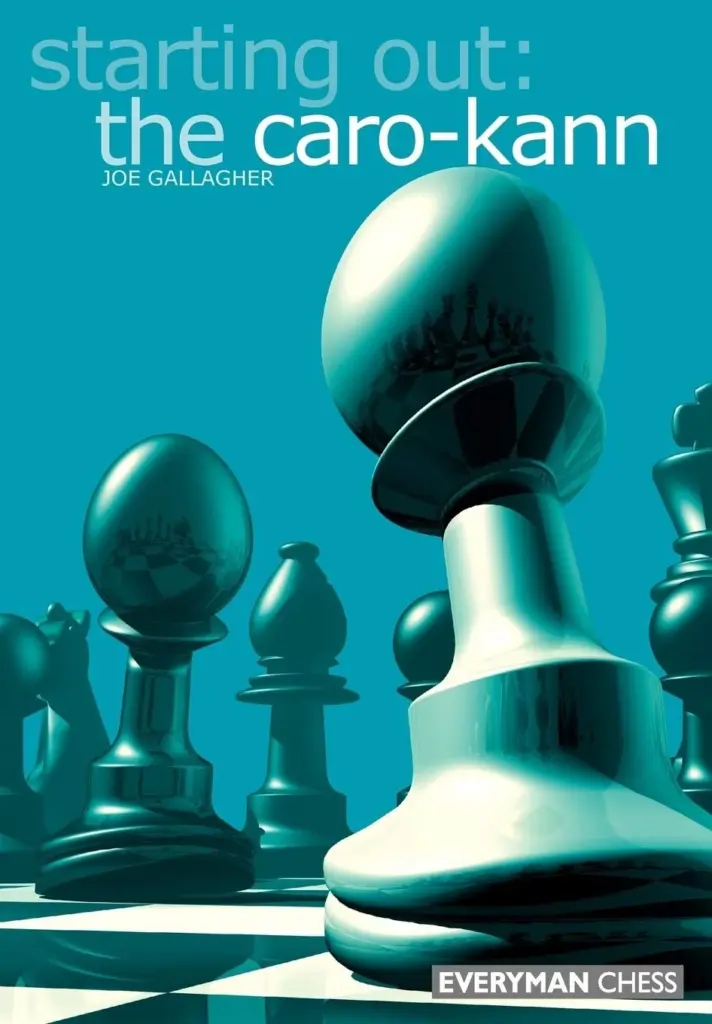
Joe Gallagher is a British-Swiss Grandmaster with years of experience and 13 books to his name. He has won the British Championship in 2001, and the Swiss Championship seven times, his final victory was in 2021. Starting Out: The Caro-Kann came out in 2002. At the time, Gallagher seems to have been focused on writing, as he published several books, including 101 Attacking Ideas in Chess, The Magic of Mikhail Tal, Starting Out: King’s Indian, Starting Out: The Pirc/Modern, and Play the King’s Indian, all in the period from 2001 to 2004.
I desperately wanted to never open this book. I was prejudiced because Gallagher has never played the Caro-Kann himself. Well, to do him justice, there is one game from 1988 where he played it, against Y. Gruenfeld. How can a player who has never played an opening write a book about it? Well, he actually did a pretty good job.
Other Books by Joe Gallagher You Might Like
- ELO: 1400
- -
- 1800

- Beating the Sicilian 3
- Joe Gallagher, John Nunn


Is the Book for White or for Black? Is it for Beginners?
It’s for both sides. Gallagher writes in the introduction that it should be used by white players looking for a weapon against c6, and for those who play the Caro with black.
I have expected the book to be much simpler than it actually is. It’s definitely not a book for beginners. I would say that 1800 FIDE is the ideal audience, but many players above 2000 would benefit from it. It’s no simpler than Houska’s Caro-Kann repertoire, and it’s far more advanced than Lakdawalas Caro-Kann: Move by Move. Schandorff’s book is definitely a level above this one, and so is Bologan’s Caro-Kann. Anyone above should focus on those two. For players below 1800, I would recommend Houska’s book, or The Caro-Kann the Easy Way by Thomas Engqvist.
This is an early attempt at playing the Caro-Kann by none other than Horatio Caro. Horatio Caro was an English player who, along with the Austrian Marcus Kann, gave the name to my favorite opening. He had black against Ignacy Kopa at the Barmen Meisterturnier B in 1905. It was the Classical Variation with Bf5. It’s Caro’s move on move 20. How would you evaluate the position?
Wanna solve more positional problems and get instant feedback just like you would during a lesson with a real chess coach? Continue training!
The Variations Covered
I was confused when reading the book since there are quite a few important openings that haven’t even been mentioned by Gallagher. For example, he covers the Van der Wiel, the Short, and 3…c5 in the Advance Variation, and he does it for both sides, but there is no mention of the Tal Variation. Why is that? It was very popular in 2002. Other important variations in the Advance have also been omitted, the Bayonet, 4.c4, 4.Ne2 to name some of them.
In the Classical, Nc3, he covers Bf5, Karpov and Nf6 well, but there is no mention of the Gurgenidze system.
He covers the Panov, the Fantasy, and, what he calls miscellaneous openings (?!), where he very briefly goes over the Exchange, the Accelerated Panov, the Two Knights, and the Breyer (KIA). There is a definite discrepancy between the full, long chapters on the Classical or the Fantasy, and those shorter overviews bundled into the same chapter.
How is the Exchange variation less important or less theory-heavy than the Fantasy? Bobby Fischer’s game alone could fill a book.
Even in the “detailed” chapters, Gallagher has left gaping holes. In the Fantasy, for example, 3…Qb6, the main line today hasn’t even been mentioned, and there are tabia games played before 2002 in the variation.
Along with the Gurgenidze, he has also failed to mention the Goldman (Nc3, Qf3), the Hillbilly (rightfully so I may add, it’s a crap opening), and other lines popular today that were played when the book was written.
That being said, the book does cover around 70% of the Caro-Kann. The biggest hole is the Tal. That one cannot be forgiven.
The Structure and Readability
This is where Gallagher stood out. Perhaps it’s the entire “Starting Out” series by Everyman, I don’t know, but the structure of the book is perfect. All the variations are explained well, and each sub-chapter consists of four unique segments. Firstly, Gallagher included short text excerpts titled “Warnings” and “Tips”. They are wonderful, very useful, and they highlight key strategic points and tactical dangers. At the end of each sub-chapter, he included detailed statistics for each variation, providing scores in practical play, as well as a brief chapter on how “theory-heavy” the variation explored it. I found all four of those uncommon, useful, and a great improvement to the book.
Struggling with learning openings? Chessbook is the fastest way to build a bulletproof opening repertoire. Collect all your openings in one place – nobody gets their whole repertoire from a single course or book. Chessbook lets you combine openings from multiple sources to create a custom repertoire just for you. Check it out!
The lines themselves are annotated well when it comes to quality of explanations, but not when it comes to quantity. Gallagher has been lazy in many variations, and didn’t fully explain all moves, sometimes leaving 4-5 move sequences blank. This makes the book very difficult to read for beginners. I would say that even very advanced players wouldn’t be able to follow the analysis without a board (or two) on the side, since he goes into many deviations and sidelines.
Conclusion
Starting Out: The Caro-Kann is a useful book on the Caro-Kann for intermediate and advanced players. It doesn’t cover every important variation, and some lines it does cover have been revisited since, but Gallagher’s analysis is almost fully applicable in tournament play today. It’s structured well, and it’s much easier to read than most other opening books.
Other Books on the Caro-Kann You Should Read
- ELO: 1800
- -
- 2200
- Playing the Caro-Kann: A Counter-attacking Repertoire
- Lars Schandorff