Introduction
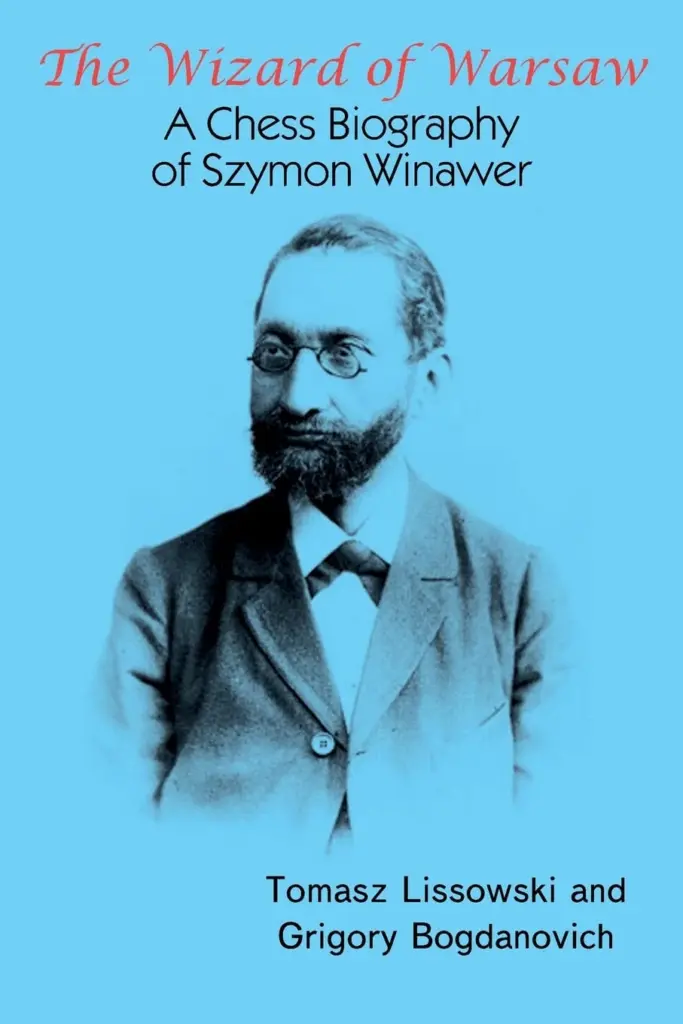
The Wizard of Warsaw is a biography and a game collection. It’s divided into two parts. In the first half of the book, Lissowski, a Polish chess historian gives insight into the life of Szymon Winawer. Alongside Winawer’s life and chess development, the author depicts the development of chess as a whole, as well as the political background and the social climate in 19th century Poland. The second half of the book is dedicated to Winawer’s games. IM Grigory Bogdanovich has annotated 123 of his best games. IM Bogdanovich has also written From Vienna to Munich to Stockholm: A Chess Biography of Rudolf Spielmann.
Winawer wasn’t a professional chess player. Unlike Alekhine or Capablanca, or other early masters, he never published annotated game collections. He isn’t as well known as his contemporaries today, which is why a biography of his is all the more important. We know a lot about Nimzowitsch, Lasker or Capablanca. Not many books have been written on players who’ve never quite reached the top.
Part 1 – The Biography of Szymon Winawer
The first part of the book is divided into 22 chapters. It begins with Winawer’s family history and ends in his final years during the early 20th century. It gives thrilling accounts of many important events in Winawer’s life and chess career. It’s not exactly a chess book, but it does feature a few historically important games here and there.
Many excerpts from publications written at the time, as well as many photographs accompany the author’s writing, giving the first part of the book true historical weight. From the beginnings of his chess career in his home town of Warsaw, to his tournament successes in London 1883, Berlin 1881, or Vienna 1882, Lissowski managed to describe what it was like to play chess on a competitive level in, for me, the dark ages of chess. I feel like all I knew about chess at the time were the games themselves. This is the first book that taught me what life was like for the players back then. Tournament conditions and regulations are described in detail, accommodation and travel arrangements, as well as many other details were captivating. Learning how a player came and actually played a London tournament 150 years ago is as interesting as reading a Sherlock Holmes adventure.
Part 2 – Selected Games
The introduction to the second part of The Wizard of Warsaw, in which 123 of his games were selected and annotated by IM Bogdanovich, begins with a quote on Winawer taken from The history of chess competitions by Nikolai Grekov: “Winawer was an infinitely resourceful and enterprising tactician, first and foremost. He paid little interest to theory, let alone the rivalry of schools of chess art, always remaining a very distinctive master with an exciting, unique talent. His greatest strength was tactics, and he was especially proficient in endgame play. He influenced quite a few prominent masters. Chigorin owes much of his tactical skill to him. Winawer was a forerunner of Lasker in the skillful use of the Ruy Lopez Exchange Variation. Finally, his influence on Rubinstein’s play is obvious, especially his incredible ability to play for some miniscule advantage from the very start of the game and then finally capitalize on it in the endgame.”
Winawer is best known today for the WInawer French, a sharp defense named after him. Here is a game played early in his career, in London in 1883 against Mortimer, where he employed the opening himself! How would you evaluate the position?
On Chessmind you can solve positional problems and get instant feedback like you would from a real coach, you can learn from numerous opening courses, practice tactics adapted to your strength, and get access to ChessGPT! Try it out!
Bogdanovich dissects this quote in the following pages, highlighting the importance of not describing Winawer as tactician, but as a well-rounded player, equal to Capablanca in endgame technique. Still, having gone through the 123 games, I can’t help but label Winawer a romantic era player, despite the author’s efforts. In many of the games he launched unjustified combinations, and his strategic understanding or technique do not come close to truly universal masters like Rubinstein or Lasker. Which is why he never became the best, even during his peak.
The game collection is divided into 7 chapters; Winawer’s style, Positional Play, Tactical Play, Subtle Endgame Play, Opening Play, Glorious Defeats, and the last recorded game. The final chapter is only two pages long, and it gives very brief analysis of a strange game Winawer played in the King’s Gambit with (if I underwood it the correctly) the Prince Dadiani of Mingrelia against several unknown players. For those curious, after doing research, I found that Mingrelia or Samegrelo was a historic province in Georgia, formerly known as Odishi. The game itself is weird and poorly annotated. After the game, the book just ends. In fact, the final sentence of the book is: “After white’s move, the game drifts towards a draw, as there’s too little material on the board.” That felt underwhelming. It felt strange to just flip the page and find that the next one is blank, not even with publisher’s credits.
But onto the first six chapters now. Bogdanovich has attempted to strip Winawer of his title of a tactical player who knew little else, so he included chapters on positional play, where he covers structures Winawer understood well, and a chapter on endgame play.
The Quality of Annotations
I must say I was underwhelmed. Like most other game collections, and Spassky’s best games, a new book by Karolyi comes to mind in particular, the annotations lack depth and they aren’t great, neither in quantity nor in quality. The instructive value of the book could have been significantly increased had the author taken more time to describe each key idea in detail.
There are 10 or more move-long segments of games left with no comment, important ideas, some of which I know from before and well known moves that were simply glanced over. In short, the annotations are kind of ok. About what you would expect from an average collection. It actually reminds me of chess books written 100 years ago.
Despite that, the book still holds instructive value. Going over Winawer’s games is very useful for players of all levels, but it will require a lot of your own analysis as the author has only provided a skeleton, a basis on which the reader must continue building while working through the book. You will need a board to read through The Wizard of Warsaw, as well as several notebooks if you wanna be thorough. It had taken me close to 50 hours to just go through the 123 games while doing analysis that definitely wasn’t done in detail.
Other Game Collections You Might Like
- ELO: 1800
- -
- 2200
- Hübner Year by Year: Volume I (1959-1979)
- Hans Renette, Tibor Karolyi
- ELO: 1600
- -
- 2000
- The Livonian Knight: Selected Games of Alvis Vitolins
- Edvins Kengis, Janis Klovans, Janis Vitomskis, Zigurds Lanka
- ELO: 1800
- -
- 2000

- Learn From the Legends, Chess Champions at Their Best (10th Anniversary Edition)
- Mihail Marin