Introduction
Bobby Fischer is remembered as one of the greatest chess players in history. He was an undisputed world champion, by far the best of his generation. From the early 60s, to the match with Spassky in 1972, he was expected to win regardless of who his opponent was.
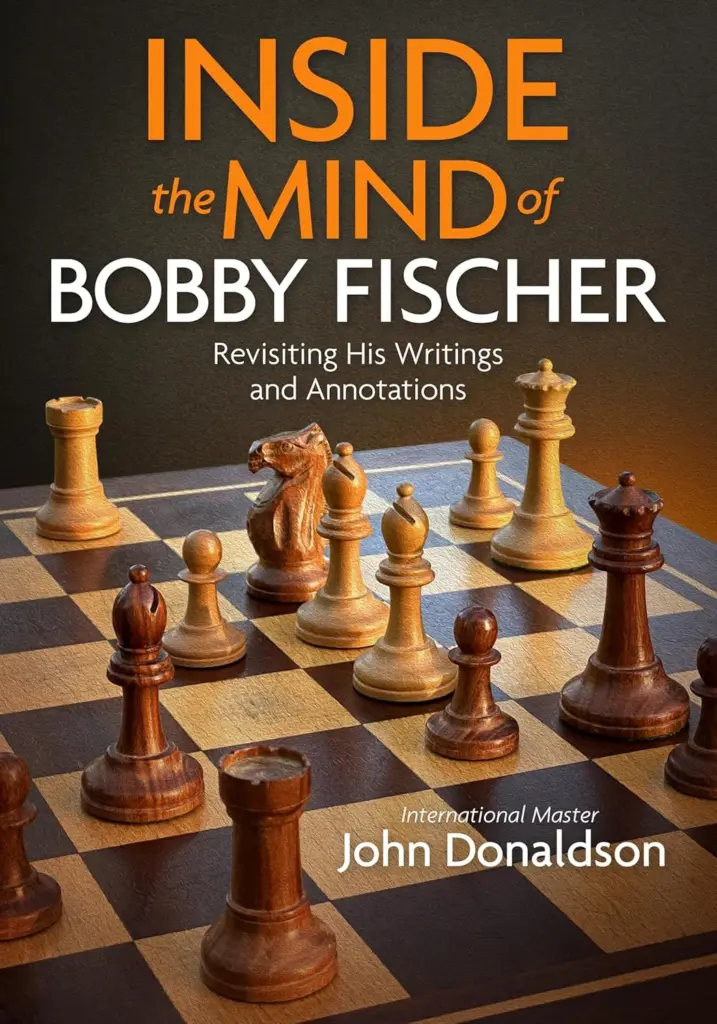
Inside the Mind of Bobby Fischer by IM John Donaldson, who served as team captain for the US teams in 26 Olympiads and World Team Championships, is a book that dissects, explains, and puts into context and perspective everything Fischer ever wrote.

Fischer was also a chess author. His two most famous books, My 60 Memorable Games, and Bobby Fischer Teaches Chess, remain among the best selling chess books today. He is my favorite player and I read almost everything he ever wrote. Almost all of Fischer’s writings were published between 1958 and 1971. Inside the Mind of Bobby Fischer by IM John Donaldson, dissects, explains, and puts into context and perspective everything Bobby Fischer ever wrote.
Donaldson uses Bobby’s original annotations, adding to them by providing the background, the context, explaining the relations between him and anyone else involved in the projects. He gives numerous appendices, photos, letters, conversations, and inside information I’ve never seen before. Inside the Mind of Bobby Fischer made me realise how little I had previously known about Bobby Fischer as an author, and how superficial my reviews of his books must have sounded to well-read chess players who understand Fischer.
Bobby Fischer’s Four Chess Books

- ELO: 1400
- -
- 1600
- Chess Meets of the Century
- Bobby Fischer, Dimitrije Bjelica

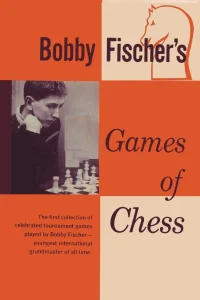
His first book, Bobby Fischer’s Games of Chess, came out in 1959, when he was 16. Donaldson mentions that he is among the youngest grandmasters to ever publish a book of his own, along with Naroditsky and his Mastering Positional Chess (age 14), Murray Chanler’s A White Pawn in Europe (age 15), and Larry Evans’ Vienna International Tournament 1922 (age 16). Donaldson argues and gives relative proof that, despite the claims of some chess historians that Fischer had not written the book himself, Bobby Fischer’s Games of Chess was his own work. He mentions that Bobby was known for giving credit where credit was due, and that he would have undoubtedly done so had he had assistance with his first book.
Bobby Fischer Teaches Chess
Bobby Fischer Teaches Chess, which came out in 1966, is another story. Fischer shares author credits with several authors, but he hadn’t written any part of this beginner’s tactics book himself. I had given the book a very negative review a while back. I was very disappointed to find that it’s basically a collection of back-rank mates for beginners without Bobby’s writing. Donaldson says that “… he didn’t play a role in the actual writing of Bobby Fischer teaches Chess. His principal contribution was his endorsement.” He goes on to mention that one of the authors, Stuart Marguiles, while on the Perpetual Chess Podcast with Ben Johnson said that Fischer was not involved in writing of the book, but that he insisted that all the presented positions were realistic and gamelike (Donaldson 2025, 177).
This is a position from a game Bobby played when he was just 13 years old, during the 1956 US Open held in Oklahoma. He had the black pieces against Albert Swank. It was Bobby’s turn on move 13. How would you evaluate this Sicilian position?
On Chessmind you can solve positional problems and get instant feedback like you would from a real coach, you can learn from numerous opening courses, practice tactics adapted to your strength, and get access to ChessGPT! Try it out!
My 60 Memorable Games
Fischer’s My 60 Memorable Games is his best book. The only good book in my opinion. It’s a great game collection covering Fischer’s games up to 1969, when the first edition by Simon and Schuster came out. The edition I read is the Batsford algebraic notation edition from 1995. That’s the one still reprinted today. Donaldson writes that “Fischer worked on 60 Memorable games for over four years – on several occasions during that time he had second thoughts and seriously considered scrapping the project altogether. An internal struggle raged inside Bobby. On one side was Fischer the perfectionist who wanted to write an honest and revealing book accessible to a wide audience of chessplayers. On the other side was Fischer the realist, who wondered if he might be giving away too many secrets, allowing the Soviets – his chief competitors – to gain crucial insights into his play.” (Donaldson 2025, 217).
Chess Meets of The Century
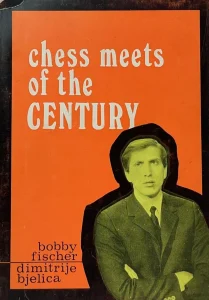
Fischer’s final book is Chess Meets of The Century, which he co-wrote with the famous Yugoslavian author and interviewer Dimitrije Bjelica in 1971. The book covered the USSR vs Rest of the World match played in 1970 and the famous Herceg Novi blitz tournament.
Fischer’s Chess Columns and Articles
Most of Fischer’s writings and annotations were published in articles and chess columns either exclusively, or only got included in his books later. Donaldson lists, explains, and dissects all of them. He wrote four tournament books; 1960 Olympiad Leipzig with Szabo, 1966 Havana Olympiad with Bednarski, and a second volume on the same event with Jimenez, and a book on the second Piatigorsky Cup with Najdorf. The annotations from all four volumes were included in his 60 memorable Games (Donaldson 2025, XIII-XIV).
Fischer wrote several chess columns. During the 60s, his column in Chess Life came out from June 1963 to December 1964. The second column came out in Boys’ Life from December 1966 to January 1970. That was a publication of the Boy Scouts of America and it was intended for a less advanced audience. Before reading Inside the Mind of Bobby Fischer, I had never seen, heard of, or read those articles before. He wrote his famous article “The Ten Greatest Masters in History” for Frank Brady’s Chessworld in 1964. HIs annotations were published in the Israeli magazine Shahmat.
Other Books on Bobby Fischer

- ELO: 1400
- -
- 1800

- Bobby Fischer: His Approach to Chess
- Elie Agur


A Bust to the King’s Gambit
Bobby wrote for American Chess Quarterly. His first article came out in 1961. It covered his weapon against the King’s Gambit. After his famous loss to Spassky in 1960 in the King’s Gambit, Fischer came up with 3…d6, what we know as the Fischer Defense today. The article was titled “A Bust to the King’s Gambit”.
Chess Informant
Most famously, Fischer contributed to the Šahovski Informator (Chess Informant), a revolutionary publication that first came out in 1966. Instead of having to go through several publications, players were able to find everything that was going on in high-level chess in one place. Donaldson says: “It soon became common knowledge that Bobby did not just study his copies of Chess Informant, he devoured them, playing over every single move and variation of each game. He became known for his ability to replay every game “blindfold” without needing to refer to the physical volume.” (Donaldson 2025, 253). Bobby annotated games for the Informant himself.
Fischer’s Annotations and Writing Style
Since this is a book on Fischer’s books, we must mention his writing. It’s superb. When Fischer annotated a game himself, his chess knowledge, and his wit could be seen from a mile away. One great example, published in American Chess Quarterly in 1963, are his notes on the Keres-Reshevsky game from the Piatigorsky Cup. For context, Fischer had debates with the Soviet analysts through chess columns. He took pride in not making mistakes during analysis, and constantly found, corrected, and publicly shared his analysis of Soviet analysis whenever it included errors. After reading the book, it’s clear that Fischer read everything. He knew every game and actually did his own analysis, discovering and correcting mistakes.
Fischer’s Debates with the Soviets
One such debate was with the Great Paul Keres. Donaldson mentions how they “repeatedly criticized each other’s analytical shortcomings in print.” Keres had white in the 1963 game against Reshevsky.
After 1.e4, Fischer wrote: “Finally, a King’s Pawn Game! After wading through dozens of degenerate QP closed games in the tournament it’s quite a relief!” After 1…e5, he continues, and this is probably the greatest annotation I have ever read: “Sammy has no interest in tangling with Keres’ renowned Sicilian smashing tactics. I have always wondered how Reshevsky would treat the King’s Gambit or the Vienna Game. It seems a pity that Keres, who is supposedly such an expert on these openings, did not have the courage to try them out, and especially against a player like Reshevsky, who is famous for his lack of book knowledge. For example, here is how the game might have gone if Keres had ventured 2.f4 exf4 (Sammy: I once saw someone play d5 but my move wins a pawn) 3.Bc4 (Sammy: What’s this? Something new has been added. I thought Nf3 was the book. He thinks he’s clever…)”. And so on. I laughed out loud reading this.
Donaldson gives numerous other refutations of Soviets’ analysis Bobby had published. He famously refuted Kotov’s analysis of the Keres Fischer game from the 1959 Candidates, and Weinstein’s (the patron of David Bronstein and a chess authority in the post WW2 Soviet world) analysis of a position in the Meran Semi-Slav from his book published in 1956. I enjoyed reading these, but, above all, my admiration for Fischer has grown significantly. His work in the 60, his diligence in analyzing every published game and going so far as to debate the original analyst, shows how hard he truly worked to become the best.
Understanding Bobby Fischer
If you want to study all of Fischer’s games, and read all of his annotations, get My 60 Memorable Games. But if you want to understand Fischer and his work, read Inside the Mind of Bobby Fischer. I have been blown away with the amount of information I didn’t know. Considering Bobby is my favorite player, I had considered myself relatively well educated when it came to his games and writings. I was wrong.
Conclusion
This is a remarkable book. It truly feels like getting a glimpse inside of Fischer’s mind. Donaldson collected all of Fischer’s writings in one place, and gave them meaning and context. For the first time, you get to understand why and how he wrote what he did, why he annotated and debated the way he did, and just how hard he worked to become the best player in history.
Lesser Known Books on Fischer You Might Like
- ELO: 1400
- -
- 1800
- Chess Exam: You vs. Bobby Fischer: Matches Against Chess Legends, You vs. Bobby Fischer
- Igor Khmelnitsky
- ELO: 1400
- -
- 1600

- Bobby Fischer’s Outrageous Chess Moves
- Bruce Pandolfini
- ELO: 1400
- -
- 1800

- Bobby Fischer: Complete Games of the American World Chess Champion
- Lou Hays