Introduction
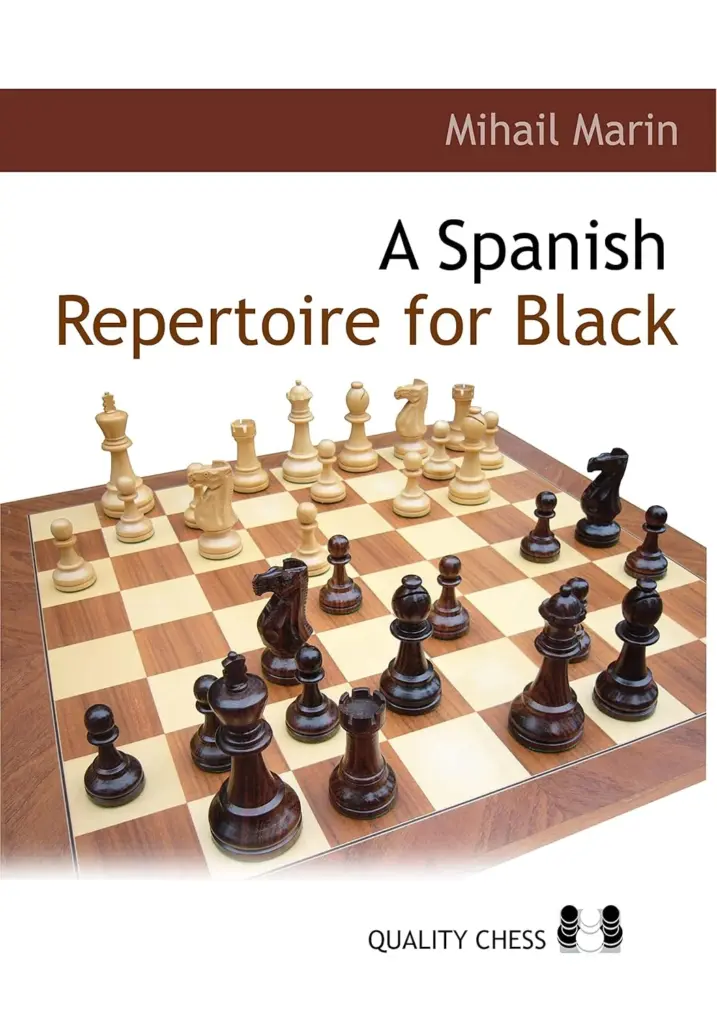
I have gone through many books on the Ruy Lopez while working on my Spanish video series. Mihail Marin’s Spanish Repertoire for Black is the only one I was blown away by. It’s an incredible resource for black based on the Chigorin Closed Ruy Lopez, but it also covers all the sidelines white could play such as the Mackenzie. It complements his Beating the Open Games, and it gives a full repertoire for black after 1. e4 e5 2. Nf3 Nc6 3. Bb5 a6 4. Ba4 Nf6. In the other book, he covers the Exchange Spanish and other open games. I have built my own Spanish repertoire for black with the Chigorin as the skeleton, so his book was incredibly useful for me personally. The objective value of the book lies in the annotations and descriptive writing Marin is famous for. A Spanish Repertoire for Black is written as well as his extraordinary game collection Learn From the Legends.

Mihail Marin is perhaps the best modern author because he is able to present very advanced material in a way a beginner could easily follow. He doesn’t use vague descriptions or engine evaluations. He explains ideas, patterns, and strategy to humans! That, believe it or not, is very rare, especially looking at chess opening books alone. There are very few books that are both an easy, and a remarkably instructive read.
Other books by Mihail Marin
- ELO: 1800
- -
- 2000

- Learn From the Legends, Chess Champions at Their Best (10th Anniversary Edition)
- Mihail Marin

- ELO: 2000
- -
- 2200+

- Grandmaster Repertoire: The English Opening, Volume 1
- Mihail Marin
Structure of the book
A Spanish Repertoire for Black is divided into 12 chapters by openings. The first six are devoted to the Closed Ruy Lopez, three to the Chigorin, which is the basis of the repertoire, and three to the Yates Variation (when white plays d4 instead of h3, allowing Bg4). The final six chapters cover deviations and rare sidelines for white on moves 5 and 6 – the Mackenzie (which Marin incorrectly calls the Central Attack; the Central attack is d4 on move 6, not 5!), the Worrall, d3, Nc3, and the Delayed Exchange. He also includes a4 systems for white, which I haven’t seen covered anywhere else.
The book begins with the main lines, and moves down to less common variations. Marin explains that in the foreword: “Each of White’s attempts to deviate from the mainstream implies a small concession and simplifies Black’s defensive task. The main line is by far the most complex from a strategic point of view. Once its basic ideas have been assimilated, the other variations become easier to understand. This aspect has convinced me to arrange the systems in what I consider an order of decreasing strategic complexity. Admittedly, a certain amount of subjectivity was involved, but I believe that the general structure is quite practical: when examining certain “side-lines” I have frequently made reference to positions from previous chapters. For the same reasons, the first chapters are also the longest. In addition, certain variations are unpopular and inoffensive at the same time, which makes detailed analysis unnecessary.” (Marin 2007, 7)
In this Ruy Lopez game, White managed to push f4-f5, which is typical a marker that things are going well. Now, the pawn has made it to f6, creating checkmate threats on g7. How would you evaluate this position?
Chessmind is a great learning platform where you can answer positional questions and get instant feedback. It recreates lesson conditions, and comes close to having a chess coach! Try it out!
The Theory (and strategy)
The best thing about Marin’s repertoire is that he covers more than theory. He explains the ideas, the structures, and the strategy. In the introduction to the first chapter, on the Chigorin, he goes in depth into the starting moves of the Closed Spanish, which is great for inexperienced players. Most other books would jump straight into 9…Na5!
He then talks about the main strategic issues for black in the Chigorin, the poorly placed knight, and he dissects the most common problematic structures. I learned more from the first 20 pages of his chapter on the Chigorin than from all other resources I ever used combined.
Take his introduction to the problem a5-knight: “The next examples will illustrate the typical problems facing Black if he fails to solve this delicate matter in an adequate way. They are not intended to discourage the reader from playing the Chigorin line, but to offer a clearer image of the kind of positions that should be avoided. All fragments are taken from games where the Ruy Lopez was played (although I was tempted to insert some games with the Yugoslav variation of the King’s Indian Defence as well). In some of them Black chose set-ups other than the Chigorin variation, but play soon took a course that is relevant for our central subject. The critical situation arises when White blocks the centre with d4-d5.” (Marin 2007, 13). He then goes on to show and explain 10 or so incredibly instructive closed Chigorin positions from various games. This is how an opening book should be written!
Marin is very humble, and he gives a detailed explanation of why he recommends the Chigorin despite not having proof that it’s superior to the other 9th moves, such as the Breyer or the Zaitsev. His book is the opposite of click-bait. He provides facts to the best of his abilities, and leaves the reader to digest them without external influence. That kind of approach to instructive literature is rare, and not just in chess.
Struggling with learning openings? Chessbook is the fastest way to build a bulletproof opening repertoire. Collect all your openings in one place – nobody gets their whole repertoire from a single course or book. Chessbook lets you combine openings from multiple sources to create a custom repertoire just for you. Check it out!
Talking about the variations he recommended, Marin writes: “I intentionally avoided fashionable systems. Experience has taught me that fashion is an unpredictable and capricious lady; after certain variations have been well-enough forgotten, they might come back into the limelight. Secondly (and more importantly I would say), the task of catching the very essence of the position in lines where theory advances with big steps (not necessarily in the correct direction) is rather difficult. It is much easier to take a photo or sketch a portrait of a virtually immobile image than to describe a highly animated scene. Instead, I have preferred to choose variations with a very long past, involving the names of great players including world champions.” (Marin 2007, 11)
Should you read Marin’s Spanish Repertoire for Black?
Yes. Whether you play the Spanish as white or defend against it as black, whether you play the Chigorin or not. Yes. You should read it even if you don’t play 1.e4 or 1…e5. Marin’s book is one of the best opening books I’ve ever read and it will teach you far more than Spanish theory. You will understand classical structures on a much higher level. You should also read it regardless of your rating since Marin explains high-level concepts in a way a beginner could follow them. 10/10!
Great repertoire alternatives to the Chigorin for Black
- ELO: 1600
- -
- 2000
- Grandmaster Repertoire: Berlin Defence
- Michael Roiz
- ELO: 1600
- -
- 2000
- The Modern Spanish: Breyer and Zaitsev Systems
- Vassilios Kotronias
- ELO: 1600
- -
- 2000

- The Schliemann Defence, Move by Move
- Junior Tay