Introduction
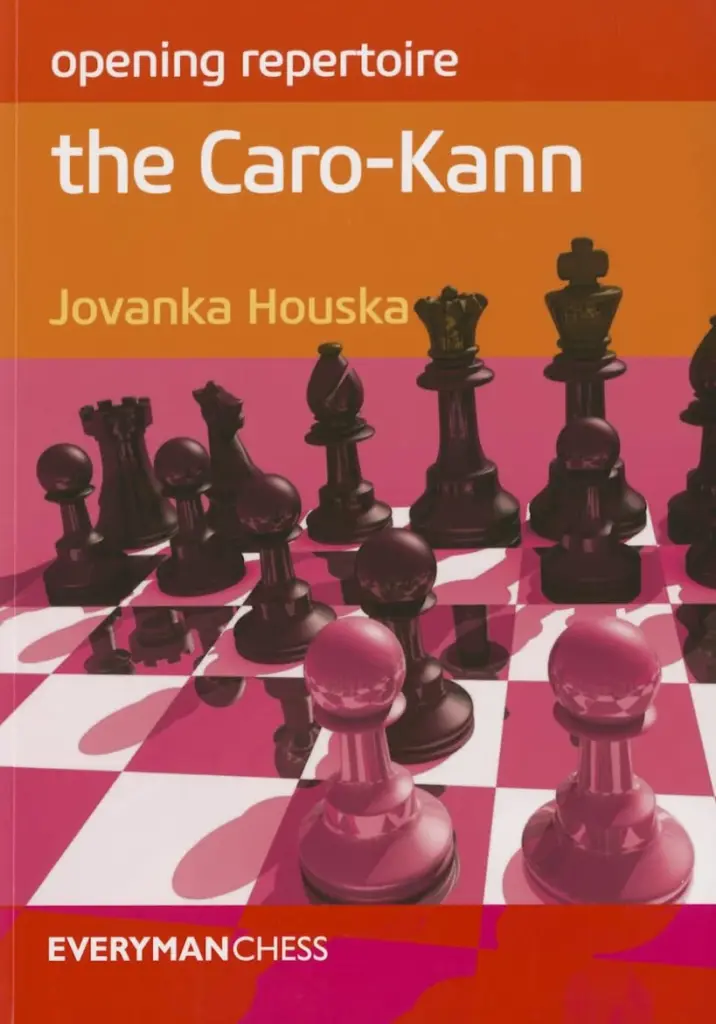
Jovanka Houska is an experienced Caro-Kann player. There are 207 recorded Caro-Kann games in which she had black in the databases. Her repertoire against d4 is similar, she plays the Slav and the Semi-Slav. If you know my repertoire, you’ll know that I’ve been playing those same openings since I started playing chess.

The fact that she plays c6 and triangle systems almost exclusively makes her work on the Caro trustworthy, and reviewing a Caro-Kann book by an experienced Caro-Kann player is a different experience to reading an “opening series” book by an author who just mass-produces books regardless of whether they have actual playing experience or on. I will not name anyone, but any experienced readers will surely know who I’m referring to.
This is Jovanka’s second book on the Caro-Kann. It came out in 2015. Her first book, Play the Caro-Kann, which came out in 2007, is also a complete repertoire against 1.e4.
Other Caro-Kann Repertoire Books
- ELO: 1800
- -
- 2200
- Playing the Caro-Kann: A Counter-attacking Repertoire
- Lars Schandorff

Introductions to Chapters and Strategic Ideas
What I like most about the book are the brief, one or two page introductions to each chapter in which Jovanka explains the basic ideas, problems and strategy. Take her introduction to the Fantasy for example, where she writes: “Despite first appearances, 3 f3 does have some positional basis to it. After all, top grandmasters have played the Fantasy Variation and one can safely say that a strong grandmaster rarely plays positionally suspect openings. With f2-f3, White bolsters the centre with pawns and gets ready to open the f-file for his rooks to attack à la King’s Gambit. The Fantasy Variation has an extraordinarily sharp character and is often accompanied by sacrifices and dangerous traps. It does, however, have a clear downside: the pawn on f3 hampers White’s development and the Achilles’ heel of White’s position is the f2-square and the weakened g1-a7 diagonal. As such, Black should adopt a dark-square strategy.”
Recommended Variations
I must say that not all the variations she recommends are to my liking. That’s, of course, subjective, and many of you would think the opposite. That doesn’t reduce the value of the book. I usually scan opening books for lines that correspond to my repertoire and read chapters selectively.
Jovanka recommends a very interesting idea against the concrete, 6.f4 attack in the Bf5 Classical variation – 7…Bd6! I have been exploring the same line myself and was delighted to have it explained in the book. One game struck me in particular when I was studying the line. Vargić had white against Ibro Šarić in 2005. It was black’s move on move 13. This position highlights just how useful a bishop on d6 can be against early f4 attacks. How would you evaluate the position? Who is better and why?
Chessmind is a great learning platform where you can answer positional questions and get instant feedback. It recreates lesson conditions, and comes close to having a chess coach! Try it out!
Nc3 Classical Systems
Against Nc3, Jovanka recommends Bf5. Nothing surprising there, as Bf5 remains the most popular defense against Nc3, although the Tartakower has seen a rise in popularity recently. Schandorff, for example, in his 2021 Caro-Kann book, has switched from Bf5 to the Tartakower. The depth of her analysis on Bf5 is remarkable. Separate chapters are devoted to 11.Bd2 and 11.Bf4, as well as Nh3-f4 and Ne2-f4 systems. Some of the lines go 20 moves deep and they are exhausting to study, but that’s what you get when you choose Bf5!
Panov-Botvinnik Attack
Against the Panov, Jovanka plays Nc6, with Bg4 to follow. That is a line that leads to the famous endgame if white wants it. She has, in her 2007 book, proposed Nb6, avoiding the endgame but allowing 10.d5. In her new book, she has switched to g6 systems. I love that. I’ve started exploring them myself recently and the fact that g6 avoids a lot of theory and reduces the risk to black’s position makes the variations less difficult to study, as there are fewer forcing lines you have to memorize. I play 5…g6 and not Nc6, and Jovanka recommends 6…g6. This move order avoids many problems of the 5…g6 6.Qb3 variation. Against 6.Bg5, she recommends e6, which I really don’t like. I play Be6 against it.
Exchange Caro-Kann
Against the Exchange, she recommends Qc7, just like in her 2007 book. 5…Qc7 avoids a lot of theory, but I still feel like the main lines are more promising for black. Still, that’s what I’ve recommended myself in my new Caro-Kann repertoire.
Advance Caro-Kann
Against the Advance Variation, Jovanka plays the Botvinnik-Carls defense, c5. Avoiding Bf5 has its merits, and you don’t have to face mad openings like the Tal or the Bayonet, but it also has strategic and positional drawbacks. Moving the c pawn twice in three moves is a concession. Her explanations of the c5 lines are great, though, and probably the best resource on the Botvinnik-Carls currently available.
Struggling with building an opening repertoire? With Chessbook you will only spend time on the moves you’ll actually see. It lets you easily identify mistakes in your online games, play through model games that follow your repertoire, learn middlegame plans for any opening and find the gaps in your repertoire before your opponents do. Try it out!
The Fantasy
Against the Fantasy I disagree with Jovanka’s incredibly sharp choice of 3…dxe4 and 4…e5. Those variations are definitely sound but they are too risky for my taste and not in line with the spirit of the opening. I play Qb6 or e6 myself and I could never stomach the complications in the open positions after dxe4 and e5.
Two Knights Caro-Kann
Against the Two Knights Attack, Jovanka, just like almost every other author on the Caro-Kann, recommends Bg4 with Bxf3. I wonder if anyone recommends the alternative 4…Bh5! That is becoming my favorite line against Nc3. Still, Bxf3 is the most solid approach. The only downside is dealing with d3, Bd2, 0-0-0 setups for white. Jovanka’s coverage of those wasn’t convincing. But, to be fair, there is no way to write about positions that are objectively worse for black and convince experienced readers of the opposite!
Rare Variations
Jovanka covers many sidelines in a single chapter, mentioning 2.b3, 2.f4, the Goldman Variation, and others. Her recommendations against most rare openings are objectively the best lines.
Conclusion
This is a good resource on the Caro-Kann. The lines are very detailed and I don’t think beginner or intermediate players would be able to read the book without having to invest several months. For more experienced Caro-Kann players, though, who can scan the chapters knowing what lines they would like to play, will be able to read selectively and focus on portions of the book that are relevant to them.
You will need a board on the side to go through Jovanka’s opening repertoire. No doubt about that. There are numerous sidelines, the variations are organized in a very confusing way, and following everything is difficult. I used two boards while reading – one for the main line, and one for the sidelines.
For an alternative to the Caro-Kann, try out these Repertoires
- ELO: 1600
- -
- 1800

- Opening Repertoire, the Open Games with Black
- Martin Lokander
- ELO: 1800
- -
- 2200
- Petroff: An Expert Repertoire for Black
- Konstantin Sakaev
- ELO: 1800
- -
- 2000

- The Hippopotamus Rises: The Re-Emergence of a Chess Opening
- Andrew Martin
- ELO: 2000
- -
- 2200+

- Grandmaster Repertoire: The Pirc Defense
- Mihail Marin