Introduction
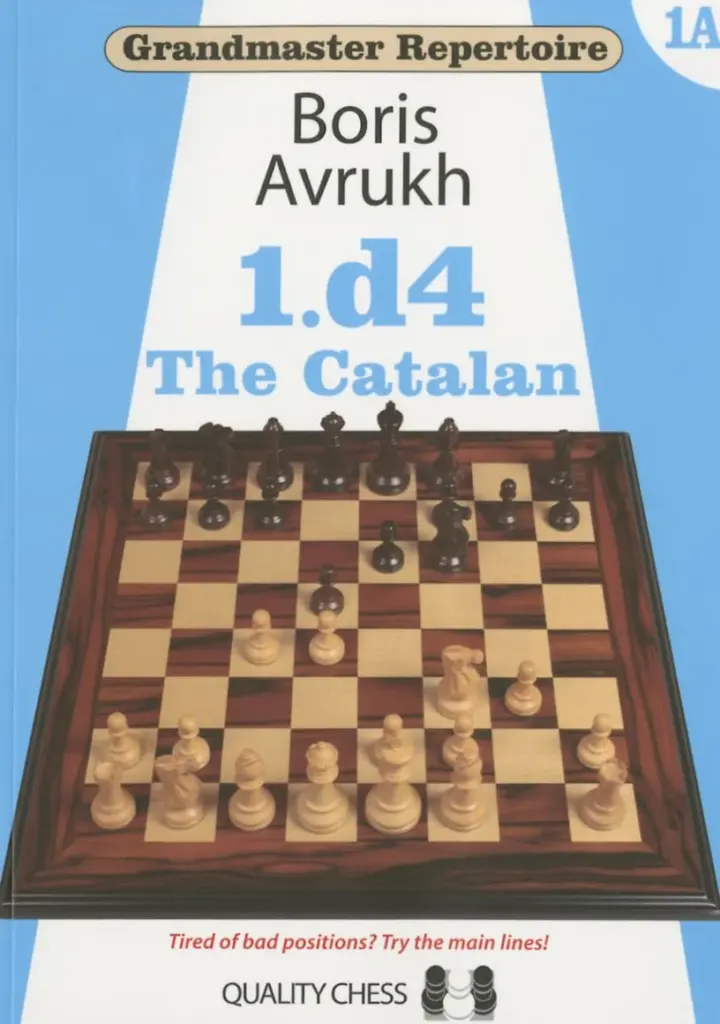
If you are positionally inclined as a player, the repertoire given by Boris Avrukh in this book will probably suit you (I am speaking from personal experience).
This book contains material from previously written books Grandmaster Repertoire 1 (Catalan) and Grandmaster Repertoire 2 (part about Benoni), but all of that from the move order 1.d4 Nf6 2.c4 e6 3.g3. From 2008 (when Grandmaster Repertoire 1 was published) to 2015 some of the evaluations have changed, so the author felt the need to update us with new verdicts about certain lines in Grandmaster Repertoire 1a.
Here’s a beautiful Open Catalan played in Israel in 2008, in which Boris Avrukh himself had white against Alexander Moiseenko. Who is better and why?
Difficulty of Avrukh’s Catalan
I believe this book is highly valuable to anyone above 2000 FIDE rating. One thing I would recommend, especially to the weaker side of this spectrum, is that they don’t believe blindly to the lines given here. Some lines are not approved by today’s engines, meaning that at moments there are slightly better moves than recommended by the author. Nevertheless, most of the lines are perfectly fine while being checked with today’s engine.
Other Opening Books by Boris Avrukh you might like

- ELO: 2000
- -
- 2200+
- Grandmaster Repertoire 2A: 1.d4 King’s Indian and Grünfeld
- Boris Avrukh
- ELO: 2000
- -
- 2200+
- Grandmaster Repertoire: Beating 1.d4 Sidelines
- Boris Avrukh
I have a feeling that Avrukh really tried to avoid as many complications in lines as possible, so if you are not very enthusiastic about learning long lines, this will be perfect for you.
Chessbook is the fastest way to build a bulletproof opening repertoire. It helps you find the gaps in your repertoire before your opponents do, pick the best moves to maximize your win-rate, and you’ll only spend time on the moves you’ll actually see in real games.
I used many of the lines given in Grandmaster Repertoire 1a with plenty of success, so I warmly recommend this book, and I wish you long, “grindy” games.
Quality of Annotations
Annotations are very clear and concise, which someone might find as a big flaw, but in my opinion the author found a nice balance between the length of the variations and length of explanations in them. Otherwise, the book would be 1000 pages long. Main ideas in each chapter are explained very well, a book is not heavy with long, complicated lines. However, I think more depth couldn’t hurt the chapters about Modern Benoni, which is the most demanding to play against.