Introduction
Lars Schandorff is a Danish Grandmaster known for his opening preparation and excellent opening books. He has written two books on the Caro-Kann; this one, which is a part of the famous Grandmaster Repertoire series by Quality Chess, published in 2010, and his new book, Playing the Caro-Kann: A Counter-attacking Repertoire, which came out in 2021. He has also written an excellent book on the Semi-Slav, an opening complementary to the Caro-Kann. If you like his writing style, and want to copy my safe e6 c6 repertoire, his three books will be more than enough.

Schandorff’s Other Opening Books
- ELO: 1800
- -
- 2200
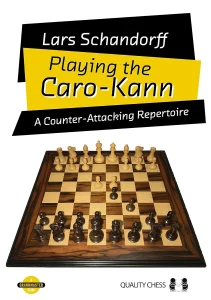
- Playing the Caro-Kann: A Counter-attacking Repertoire
- Lars Schandorff
Now. You should choose between his 2010 Caro-Kann book and his new 2021 book. You probably don’t need both. They are both well written. The new, counter-attacking repertoire, is uptodate, or more uptodate. The biggest change between the two books is that Schandorff switched to the Tartakower from Bf5 against the Classical. The majority of other recommendations are the same, with the exception of additional choices and alternatives for black added in the new book.
One thing that must be said is that Schandorff plays the Caro-Kann himself. He does play the Sicilian and other defenses too, but he has around 80 classical games with c6, so he is both a great theoretician and he has over-the-board experience.
This is the famous 9th game from the Botvinnik – Tal World Championship Match played in 1960. Botvinnik, of course, had the black pieces. Tal didn’t play the Caro-Kann. It was a Classical Caro-Kann, and Tal sacrificed a knight on e6 on move 11, a sacrifice he had been preparing since round 5 of the match, where they reached the same position. The first time Tal had that position, he didn’t take despite spending a long time on move 11. In game 9 he took. Fast forward 10 moves later and we have this interesting position on move 21 for Botvinnik. How would you evaluate it?
Wanna solve more positional problems and get instant feedback just like you would during a lesson with a real chess coach? Continue training!
Quality of Annotations
To understand the annotations in this book, it’s enough to be familiar with the standards of the Grandmaster Repertoire series. The series, published by Quality Chess, is the single best resource for serious opening study. Jacob Aagaard, who, I believe, worked as an editor on all the books in the series, ensured high quality. The variations are clearly structured, the annotations are much more detailed than in other opening books, even when comparing Schandorff’s 2021 Caro-Kann, and the layout is flawless. Grandmaster Repertoire books are simply of superior quality to all other opening books ever written. So if you’re thinking of getting one, a detailed review isn’t obligatory, you can count on the uniform quality.
Take the explanation of 15.Qe2 in the Bf5 Classical for example: “A logical follow-up; White prepares Ne5. It was also possible to bring the g3-knight back into the game or, rather, exchange it for a proper piece. 15. Ne4 0-0-0 Usually I advocate castling on the other side, but here going queenside is tempting because of the vulnerable position of the white queen (for all that, 15 … 0-0 also seems fine).” (Schandorff 2010, 34). This is an opening book you can actually read! As opposed to his 2021 book, the annotations are written in a way a beginner could understand, and there are more of them. Another good example is his description of Kb1 in the Classical: “Always a good prophylactic move; the king is better on b1 than c1, no doubt about it. On the other hand, an important feature in chess openings is the speed of development and the ability to quickly create threats. From that perspective, Kb1 is too slow.” (Schandorff 2010, 39).
Grandmaster Repertoire: The Caro-Kann is a well annotated book. Each variation comes with a brief conclusion, highlighting the important ideas, albeit very briefly. I wish they were more beginner friendly.
Difficulty
This, same as all other books in the series, is a tough read. It’s intended for strong players looking to build a proper repertoire. I think it’s best suited for players above 2100 FIDE, although it’s viable for super-GMs as well. Lower rated players may wish to find a simpler book, such as Starting Out: The Caro-Kann.
Struggling with learning openings? Chessbook is the fastest way to build a bulletproof opening repertoire. Collect all your openings in one place – nobody gets their whole repertoire from a single course or book. Chessbook lets you combine openings from multiple sources to create a custom repertoire just for you. Check it out!
Recommended Variations
The first eight chapters (!) cover the Bf5 classical. That’s the most detailed part of the book. In his new book, Schandorff switched to the Tartakower. The majority of other recommendations haven’t been changed in the 2021 book.
Against the Advance, he, same as in the new book, recommends Bf5, and covers every opening in detail; the Short, the Tal, Nc3, g4, f4, and others. I can’t decide whether I like his Anti-Advance recommendations better in the new book, though, as he gives additional alternatives there, but doesn’t annotate them as well as in this book.
In the Panov he plays Bg4 in the four knights, which I really don’t like. I prefer Be6, which Bologan has covered in detail. Against Bg5, he plays dxc4. This seems to be the modern treatment that avoids c5 structures with a majority for white. I like those lines but still prefer Be6 slightly. The same recommendation remained in the new book.
Against the Exchange, he recommends the trendy Qc7. Not a big fan, but I understand his choice. It’s annoying to play the main-line exchange.
Against the Two Knights, he recommends Bg4 with Bxf3, pretty standard, that’s what I play as well.
Against the Breyer he plays e5 and Bd6, just like Bologan. Again, not my cup of tea, I play g6 setups. Against the Fantasy he surprised me. He chose sharp lines with dxe4 and the immediate e5. I play e6 or Qb6, and avoid going into exactly what white wants.
Conclusion
This is a great resource for Caro-Kann players. Schandorff doesn’t cover everything, but gives a complete repertoire, covering every sideline, including rare stuff like the Goldman Variation. The book is annotated well, much better than his new Caro-Kann book, and is, therefore, better suited for lower rated players, but it’s still best suited for players above 2100 FIDE.