Introduction
My Best Games of Chess 1908-1937 is a collection of 219 games played and annotated by Alexander Alekhine. Taylor Kingston has combined two volumes of Alekhine’s games, 1908-23 and 1924-37, originally published in the first half of the 20th century, into a single book using all of Alekhine’s original notes, analysis and annotations. Not much has been added or changed, except for a few spelling mistakes. Engine evaluations have been added as well. Alekhine’s annotations are written for advanced players. You get the feeling that he didn’t care much about his readers’ chess skills, nor had he ever worried his analyses would be hard to follow.
Other books written by Alexander Alekhine
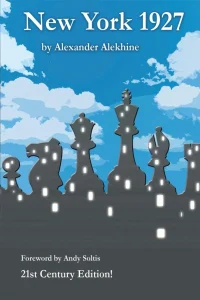


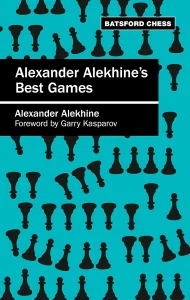
Alekhine, an aristocrat, a proud and highly confident man lived his life, played chess, and wrote the same way – to his liking. That is why the book and his annotations are good. Along with New York 1924, another one of his gems, this game collection is one of the few old chess books still almost entirely applicable today. It’s not outdated, except when it comes to opening theory, and his strategic and dynamic understanding are as good if not better than that of any modern author.
Alekhine’s Career
Kasparov wrote in the first volume of My Great Predecessors: “Alekhine’s fantastic combinative vision was based on a sound positional foundation, and was the fruit of strong, energetic strategy. Therefore, Alekhine can safely be called the pioneer of the universal style of play, based on a close interweaving of strategic and tactical motifs. Alekhine was clearly ahead of his time in his approach to chess.” Bobby Fischer is known to have revered Alekhine. He named him to be the most influential player in history. Alekhine’s games are studied today and there is no difference between analyzing them and that of modern masters like Nakamura or Carlsen. He has contributed greatly to chess theory, and his ideas can be seen in 19 (!) separate Alekhine Variations known today. The greatest, of course, is the Alekhine Defense.
Alekhine, known for many things, has given a name to one of the sharpest defenses to e4 – the Alekhine. Here is a position from a game in which he employed it himself against Thomas in Baden Baden 1925. How would you evaluate it?
Chessmind is a great learning platform where you can answer positional questions and get instant feedback. It recreates lesson conditions, and comes close to having a chess coach! Try it out!
He played everything and he didn’t stick to a certain style. Unlike Capablanca, Spielmann, or Tartakower, Alekhine could grind a 70-move endgame or win a 20-move tactical miniature with the same brilliant tenacity.
Alekhine’s career can be divided into four parts. His early years, until the beginning of the first World War, his absence from history and from chess during the war, his peak, after his emigrating to France in 1921 until the beginning of the second World War, and the sad war and post war years. The book covers games he played from 1909 to 1933.
From 1921, until 1927, when he became the World Champion by defeating Capablanca, Alekhine was, without a doubt, the strongest player in the world. After the match his decline began. That’s best visible in his defeat to Euwe in 1935. Despite regaining the title less than two years later, Alekhine no longer played his best chess.
219 Annotated Games
Alekhine’s analysis is unlike that in modern chess books. It almost feels like comparing Shakespeare to the Dan Browns of today. There is no fluff, no unnecessary, empty phrases, no relying on engine evaluations (of course). He is brief, honest, and brutal in places, evaluating positions as if he were the god of chess. I like that. Most of the text is pure “chess talk”. No anecdotes, no trivia, pure analysis.
That makes the book difficult to digest compared to modern game collections. His goal wasn’t to entertain but to give objective evaluations of key positions from his games.
The book is divided into six parts by years; 1908-20, 1920-23, 1924-27, 1929-34, 1934-37, and the final part, which covers his simultaneous and blindfold games from 1924-33. A fact you probably didn’t know is that Alekhine’s record is 32 simultaneous blindfold games! And not against amateurs either, which is how exhibitions were mostly played then and are still played today. He played 32 boards blindfolded against proper chess players.
Part three covers his match against Capablanca and the great results he had leading up to it. Part two covers most of his major tournament successes including Carlsbad 1923, Vienna 1922, Hastings 1922, and more.
Difficulty and Learning Potential
Unlike most old chess books, this game collection holds incredible instructive value. Alekhine’s analysis is focused on strategic patterns and tactical motifs, and he backs up every idea he mentions. I like how he mentions similar games very often, giving you a chance to see the same variation or the same idea in several other examples.
The book may be hard to follow for inexperienced players. You will definitely need a board on the side even if you’re advanced or master level. I would say it’s best suited for players between 1800 and 2000 FIDE, but extremely useful even at GM level. Beginners should stick to simpler game collections since Alekhine wrote annotations on the level appropriate for his own chess understanding.
Other similar game collections you might like

- ELO: 1800
- -
- 2000
- American Dream: The Best Games of Hikaru Nakamura
- Cyrus Lakdawala