Introduction
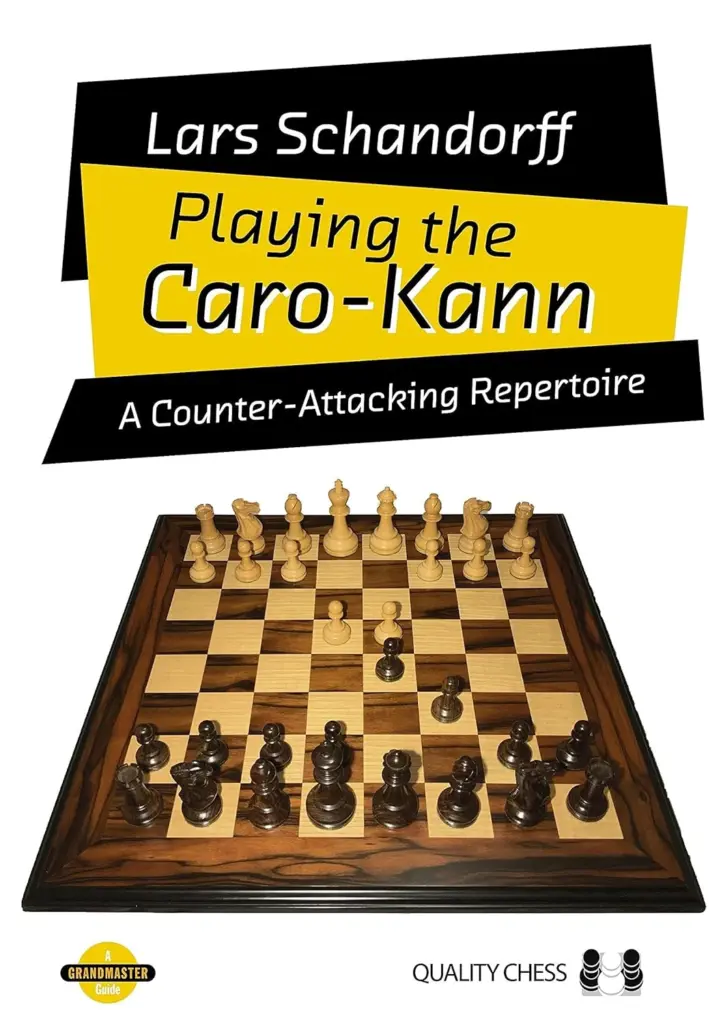
Lars Schandorff is a Danish Grandmaster known for his opening preparation and excellent opening books. He has written two books on the Caro-Kann; this one, Playing the Caro-Kann: A Counter-attacking Repertoire, which came out in 2021, and the 2010 book on the Caro-Kann that came out as part of the Quality Chess Grandmaster Repertoire series. He has also written an excellent book on the Semi-Slav, an opening complementary to the Caro-Kann. If you like his writing style, and want to copy my safe e6 c6 repertoire, his three books will be more than enough.

Now. You should choose between his 2010 Caro-Kann book and his new 2021 book. You probably don’t need both. They are both well written. The new, counter-attacking repertoire, is uptodate, or more uptodate. The biggest change between the two books is that Schandorff switched to the Tartakower from Bf5 against the Classical.
Schandorff’s Other Opening Books
Schandorff writes in the introduction: “The single biggest change from Grandmaster Repertoire 7 occurs in the Classical Variation after 1.e4 c6 2.d4 d5 3.Nc3 dxe4 4.Nxe4, when I recommend the fashionable 4…Nf6 5.Nxf6† exf6 instead of the typical Caro-Kann move 4…Bf5, which I covered in the original book. Nothing is wrong with my former recommendation – as a matter of fact, Black has solved every problem to have arisen in the past decade – but my new recommendation leads to more strategically demanding play and in my opinion gives Black excellent winning chances.” (Schandorff 2021, 6) And then: “There is nothing wrong with my previous recommendation from Grandmaster Repertoire 7, so you may ask: why change the recommended variation? The past decade has seen the rise of an almost forgotten way of playing with Black, which is extremely direct and dynamic.” He goes on to say that his new love is the Tartakower. Personally, as you may know, I dislike both moves and play the Karpov when white plays Nd2, and when they play Nc3, I play the Gurgenidze. I can’t make either Bf5 or Nf6 with exf6 work. So the part of both his books on the Classical was useless for my repertoire, but I leave it up to you to choose your weapon. His coverage of the two moves is as good as those of other authors, if not better.
Harry Pillsbury had white in this Tartakower Caro-Kann game against Horatio Caro played in Vienna in 1898. Horatio Caro was an English player who, along with the Austrian Marcus Kann, gave the name to my favorite opening. This is one of the earliest 1…c6 games at the top level ever played. Caro is down a pawn on move 25 and it’s white to play. How would you evaluate the position?
On Chessmind you can solve positional problems and get instant feedback like you would from a real coach, you can learn from numerous opening courses, practice tactics adapted to your strength, and get access to ChessGPT! Try it out!
The majority of other recommendations are the same, with the exception of additional choices and alternatives for black added in this book. For lower rated players, neither book is suitable, since Schandorff writes on GM level, and for advanced players, especially above 2300 FIDE, this new book may be a better option since it covers numerous additional lines, some introduced into master play in the 10 years since the Grandmaster Repertoire came out.
For comparison’s sake, Playing the Caro-Kann: A Counter-attacking Repertoire is around 100 pages longer, and thus written in more detail as well.
One thing that must be said is that Schandorff plays the Caro-Kann himself. He does play the Sicilian and other defenses too, but he has around 80 classical games with c6, so he is both a great theoretician and he has over-the-board experience.
Quality of Annotations
First let me say that the book is written in great detail. He covers most variations 11-14 moves deep, unless a line is forcing, then it sometimes goes deeper. That may not seem that extensive, but where he shines is mentioning more sidelines than many other books. For comparison, Bologan followed the lines more deeply, but covered fewer sidelines. That was, at least, my feeling without doing proper statistical analysis.
Looking for an easy way to learn openings and build a repertoire? With Chessbook you can find the gaps in your repertoire before your opponents do. You will only spend time on the moves you’ll actually see, learn middlegame plans for any opening, and easily find mistakes in your online games. Connect your Chess.com or Lichess account to get instant feedback when you deviate from your repertoire. Try it out!
The annotations are …ok. They are the reason I don’t really find his books enjoyable. Reading his opening books feels like hard work. For example, here is a note to a sideline on move 10 in the Tartakower: “10.Bb3 was seen in Zapata – Boersma, Amsterdam 1986. Black can obtain a good game with: 10…a5!?N 11.a4 (11.c3?! a4 12.Bc2 Re8 is comfortable for Black, who can put the bishop on e6.) 11…Re8 Followed by …Re6 and recapturing with the rook, rather than the pawn, which would give Black a rigid structure as explained before.” (Schandorff 2021, 25). The main move, 10.Bd3 has no annotations, and the sideline is annotated dryly. An example game and a line that is supposed to explain how black can obtain a “good game”. What does that mean? I dislike annotations like these. They presume the reader will explore the variations further on their own, and actually analyze Zapata-Boersma. Now, I actually did that. Would you?
I think most people wouldn’t, which is why the book loses practical value for readers who aren’t curious, skeptical, and who don’t wish to spend hours reading every page.
He also gives full games to accompany some of the variations. Take game 7, for example. The game Hector Walsh – Nikolai Ninov spans from pages 253-257. It’s 58 moves long, and, altogether, 14 moves are accompanied by annotations, and some of them are a single sentence or even a single word, such as: “43.Kd2 Kb4–+ is no better.” (Schandorff 2021, 257). I understand that this is an opening book, and not a game collection, but I found the amount of text to be severely lacking.
Recommended Variations
He recommends the Tartakower with exf6 against Nc3. Against the Advance, he, just like Bologan, recommends Bf5. Against the Short, he plays the early c5, 1.e4 c6 2.d4 d5 3.e5 Bf5 4.Nf3 e6 5.Be2 c5. That’s an interesting variation, I play Nd7 instead, but his coverage of c5 was excellent.
Against the Tal, Schandorff recommends h5, which is standard. All the other advance variation openings are covered well. Against 4.c4, for example, unlike Bologan, he plays the main lines, with Ne7. Against the Van der Wiel, he also recommends the main lines with the quick c5. All in all, except for c5 against the Short, he plays the main lines in the Advance.
In the Panov he plays Bg4 in the four knights, which I really don’t like. I prefer Be6, which Bologan has covered in detail. Against Bg5, he plays dxc4. This seems to be the modern treatment that avoids c5 structures with a majority for white. I like those lines but still prefer Be6 slightly.
Against the Breyer he plays e5 and Bd6, just like Bologan. Again, not my cup of tea, I play g6 setups. Against the Fantasy he surprised me. He chose sharp lines with dxe4 and the immediate e5. I play e6 or Qb6, and avoid going into exactly what white wants.
Conclusion
This is a good Caro-Kann repertoire book, but it’s far from perfect. Leaving aside the fact that I’m not a fan of many variations Schandorff recommends, his annotations are what make it subpar in my opinion. They are neither detailed enough, nor descriptive enough, and there should have been much more of them. It’s a great resource for advanced players, but those just starting out will feel overwhelmed and confused.
Other Repertoires for Black You Might Like
- ELO: 1600
- -
- 2000

- The Triangle System, Noteboom, Marshall Gambit and other Semi-Slav Triangle lines
- Ruslan Scherbakov