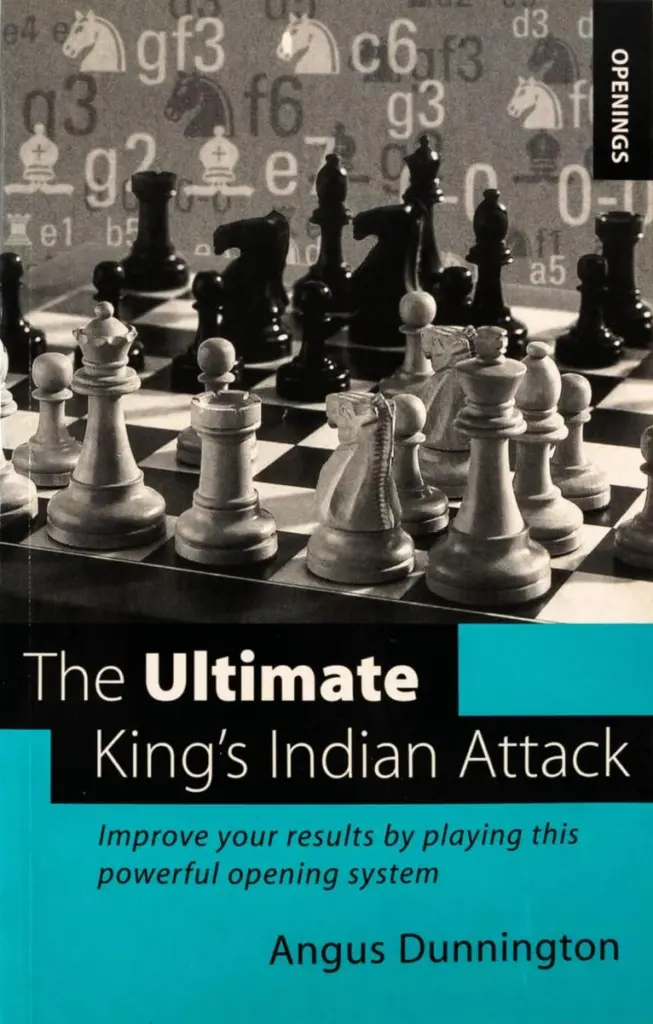
Introduction
The purpose of this book is to help people play the King’s Indian Attack. It is as much an opening book as it is a middlegame book. Rather than presenting theory, the author shows you a collection of great games played (and won) against each of Black’s various responses. You’ll see great wins from Fischer, Smyslov, Psakhis, and many others.
Structure of the Book
The book is structured thematically based on the setup Black chooses against the King’s Indian Attack (KIA). There are chapters on KIA vs. French, KIA vs. Sicilian, KIA vs. Caro-Kann, and other systems such as 1.Nf3 followed by …d5 and …Bg4 from Black.
Each chapter consists of model games where White wins, often in spectacular fashion.
To see a sample position from the book, let’s look at the following positional exercise:
Quality of Annotations
I really enjoyed the annotations for this book. They have plenty of explanations and are generally easy to follow and fun to read. The only downside I would call out is that this book does not attempt to be objective, so sometimes there’s an excessive emphasis on the “happy path” (how White can win) and not enough attention given to lines where the King’s Indian Attack does not fare so well.
How difficult is The Ultimate King’s Indian Attack?
I think the main target audience for this book is players with a FIDE rating between 1400 and 2000. I read this book when I was around 1900 in strength, and found it inspiring, but once I was 2300, relying on the same ideas did not work as well against IM-level opposition.
Here’s a great tool for learning openings and building an opening repertoire.
Chessbook allows you to import and practice your repertoire. It focuses on moves people actually play as well as your mistakes. Connect it to your lichess or chess com accounts to correct the biggest gaps in your repertoire!
How should you use the book?
The book is not too long, and the chapters are very accessible. If you are learning how to play the King’s Indian Attack, my recommendation is to read this book cover to cover, but you can start from the most common continuations (such as French and Sicilian setups). The chapter on …d5 and …Bg4 can be safely skipped if you do not play to start with 1.Nf3.
As usual, I recommend reading this book by replaying the moves on a physical board. That’s exactly what I did, and it helped me a lot to gain a deeper understanding of the material.
Conclusion
The King’s Indian Attack is not a bulletproof system for top-level results, but it’s definitely a fun opening to play under 2000 FIDE, and I would wholeheartedly recommend this book for such players. You’ll learn how to play this opening and the early middlegame and even improve your overall chess understanding in the process. I’d read it again if I was in this rating range.
Other great books on white openings:

- ELO: 2000
- -
- 2200+

- Opening for White According to Kramnik 1.Nf3, Volume 1
- Alexander Khalifman
- ELO: 2000
- -
- 2200+
- Opening for White According to Anand 1.e4, Volume 1
- Alexander Khalifman